
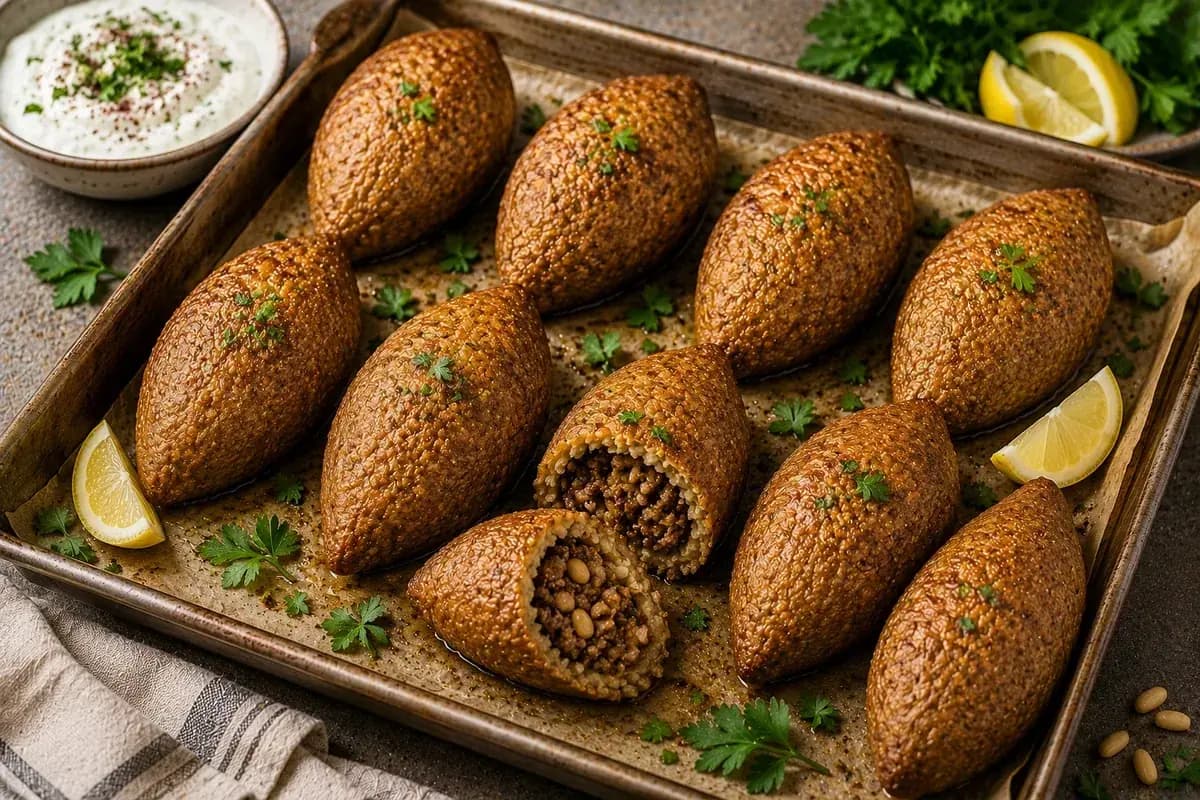
Baked Kibbeh Recipe
A healthy baked kibbeh recipe made with fine bulgur, lean ground beef, fresh herbs, pine nuts, and warm Lebanese spices. This oven-baked kibbeh bil sanieh has a tender bulgur-beef crust, savory filling, and golden finish with less oil than fried kibbeh.
Prep Time
40 mins
Cook Time
45 mins
Total Time
85 mins
Servings
8
A TASTE OF TRADITION
The Story Behind This Recipe
Few dishes tell the story of Lebanese home cooking quite like kibbeh. At first glance, it may look like a simple combination of bulgur and meat, but the finished dish reveals a much more careful tradition: finely textured bulgur and beef form a delicate outer layer, while a fragrant filling of browned meat, onions, and toasted pine nuts sits quietly at the center. When the first piece is lifted from the tray, the contrast between the golden crust and savory middle is part of what makes kibbeh so satisfying.
Cultural & Culinary Context
Kibbeh has long held an important place in Lebanese and wider Levantine cooking, with countless family versions shaped by region, season, occasion, and personal taste. It can be shaped into individual pieces, fried until crisp, cooked in broth, or layered into a tray and baked as kibbeh bil sanieh. The tray version is especially welcoming for a family table because one carefully prepared dish can be shared among everyone. The familiar diamond scoring across the top is more than decoration: it divides the baked kibbeh into portions and gives the surface its characteristic appearance.
What Makes It Mediterranean?
The Mediterranean character of baked kibbeh comes from the balance of simple ingredients and aromatic seasoning. Bulgur provides the grain foundation, lean beef supplies savory depth, olive oil brings richness, and parsley and mint add freshness. Allspice, cumin, cinnamon, and paprika create the warm spice profile associated with Levantine cooking without requiring a heavy sauce. Toasted pine nuts add a delicate crunch and a nutty aroma to the center. Served with fresh vegetables, yogurt, tahini, or salad, baked kibbeh becomes part of a generous Mediterranean-style meal rather than standing alone.
Mediterranean Influences
- 🌿Fine bulgur provides the traditional grain base.
- 🌿Extra virgin olive oil adds richness without deep-frying.
- 🌿Parsley and mint bring fresh herbal flavor.
- 🌿Allspice, cumin, cinnamon, and paprika create a warm Levantine spice profile.
- 🌿Toasted pine nuts add texture and nutty flavor to the filling.
- 🌿The dish pairs naturally with fresh vegetables, salads, yogurt, and tahini.
- 🌿Baking turns a traditionally rich dish into a lighter home-style preparation.
Ingredients
- 1 cup fine bulgur wheat (Use fine bulgur rather than coarse bulgur.)
- 500 g lean ground beef (Divided between the kibbeh shell and filling.)
- 1 large onion (Finely chopped and divided.)
- 0.25 cup fresh parsley (Finely chopped.)
- 2 tbsp fresh mint (Finely chopped.)
- 2 tbsp pine nuts (Lightly toasted.)
- 2 tbsp extra virgin olive oil
- 1 tsp ground allspice
- 1 tsp ground cumin
- 0.5 tsp ground cinnamon
- 0.5 tsp paprika
- 1 tsp sea salt
- 0.5 tsp black pepper
- 1 tbsp olive oil for brushing
Instructions
- 1
Place the fine bulgur in a bowl and cover with warm water. Let it soak for about 20 minutes until softened.
- 2
Drain the bulgur very well, then squeeze it firmly in your hands or through a clean kitchen towel to remove as much excess water as possible.
- 3
Divide the ground beef into two portions. One portion will form the outer kibbeh mixture and the other will become the savory filling.
- 4
Combine the bulgur with half of the ground beef, half of the chopped onion, parsley, mint, allspice, cumin, cinnamon, paprika, salt, and black pepper.
- 5
Process the mixture in a food processor in batches if necessary until it becomes cohesive, smooth, and finely textured. Avoid over-processing into a paste.
- 6
Heat the olive oil in a skillet over medium heat and cook the remaining onion until soft and lightly golden.
- 7
Add the remaining ground beef and cook until browned and fully cooked, breaking it into small crumbles as it cooks.
- 8
Stir in the toasted pine nuts and cook for another 1–2 minutes. Remove the filling from the heat and allow it to cool slightly.
- 9
Preheat the oven to 190°C (375°F). Lightly grease a baking dish with olive oil.
- 10
Wet your hands lightly and press half of the kibbeh mixture evenly into the bottom of the dish, creating a compact layer of even thickness.
- 11
Spread the beef and pine nut filling evenly over the first layer, leaving a small border around the edges.
- 12
Cover with the remaining kibbeh mixture. Press and smooth it gently so the filling is completely enclosed.
- 13
Dip a knife in water and score the surface into traditional diamond shapes without cutting all the way through.
- 14
Brush the surface lightly with olive oil, paying particular attention to the scored lines.
- 15
Bake for 40–45 minutes, or until the surface is firm and golden brown and the edges are lightly browned.
- 16
Allow the kibbeh to rest for about 10 minutes before cutting. This helps the layers set and makes the diamond pieces easier to lift.
- 17
Serve warm with a fresh salad, cucumber, yogurt, tahini sauce, or other Mediterranean accompaniments.
SET YOURSELF UP FOR SUCCESS
Before You Cook
👨🍳 Keep In Mind
- •Use fine bulgur rather than coarse bulgur. Fine bulgur creates the delicate texture needed for the outer kibbeh layer.
- •Drain and squeeze the soaked bulgur extremely well. Excess water can make the kibbeh mixture loose and difficult to shape.
- •Keep the two portions of ground beef separate from the beginning so you do not accidentally use the filling meat in the outer mixture.
- •Toast the pine nuts gently and watch them closely because they can go from golden to burnt quickly.
- •Allow the cooked filling to cool slightly before assembling the kibbeh so it does not soften the outer layer.
- •Have a small bowl of water nearby when assembling. Slightly damp hands make the kibbeh mixture much easier to spread.
- •Choose a baking dish that allows the kibbeh layers to remain reasonably even rather than making one very thick center.
💡 Helpful Tips
- •The key to good kibbeh texture is moisture control. The bulgur should be softened but not waterlogged.
- •Process the outer mixture until cohesive and finely textured, but stop before it becomes a completely smooth paste.
- •Press the first layer firmly enough to remove gaps, but do not compact it so aggressively that the finished kibbeh becomes heavy.
- •Spread the filling evenly so every diamond has a similar amount of savory center.
- •Use a wet knife when scoring the top to make clean diamond lines.
- •Brushing olive oil into the scored lines helps the surface develop an attractive golden finish.
- •Let the baked kibbeh rest before cutting. Cutting immediately can cause the layers to separate.
- •For the cleanest presentation, use a sharp knife and wipe it between cuts.
👀 How Do I Know It's Done?
- ✓The surface should be firm and golden brown.
- ✓The edges should have developed a deeper golden color.
- ✓The center should feel set rather than soft or wet.
- ✓The cooked beef filling should already have been fully cooked before assembly.
- ✓The kibbeh should rest for about 10 minutes before cutting so the layers can settle.
- ✓A clean cut should reveal a distinct outer layer and an even savory filling.
Tweak It
Make This Recipe Work for You
Adapt the recipe to your ingredients, dietary needs, budget, time, serving size, or meal-prep plans.
🔄 Ingredient Substitutions
Use lamb instead of beef
Ground lamb creates a richer, more traditional variation with a deeper savory flavor.
Use walnuts instead of pine nuts
Finely chopped toasted walnuts provide a slightly bolder, earthier crunch in the filling.
Adjust the fresh herbs
Use more parsley for a greener flavor, or increase the mint slightly for a fresher finish.
🌱 Dietary Adjustments
Keep it dairy-free
The baked kibbeh itself contains no dairy. Serve it with tahini, salad, or dairy-free accompaniments instead of yogurt.
Keep it egg-free
The recipe does not require eggs as a binder, so it can remain egg-free as written.
Increase the fiber
Serve smaller portions of kibbeh with a generous lentil, parsley, cucumber, tomato, or leafy salad.
💰 Budget-Friendly Options
Skip the pine nuts
Pine nuts can be expensive. Omit them or replace them with a small amount of toasted sunflower seeds or walnuts.
Stretch the meal
Serve moderate kibbeh portions alongside a large salad, lentil dish, roasted vegetables, or yogurt to feed more people.
⏱️ Time-Saving Options
Prepare the filling ahead
Cook the beef, onion, and pine nut filling earlier in the day and refrigerate it until assembly.
Prepare the bulgur mixture ahead
The outer mixture can be prepared ahead and refrigerated until you are ready to assemble the tray.
Assemble before guests arrive
Assemble and score the kibbeh ahead of time, refrigerate it, and bake it closer to serving.
👨👩👧👦 Serving Adjustments
For four people
Halve the ingredients and use a smaller baking dish while keeping the two layers evenly proportioned.
For a larger gathering
Multiply the ingredients and use two dishes rather than making one extremely thick tray. This helps the kibbeh bake evenly.
🥡 Meal Prep
Freeze before baking
Assemble the tray and score the surface, then freeze it well wrapped. Thaw safely in the refrigerator before baking.
Use leftovers for lunch
Reheat individual pieces gently and serve with cucumber, tomatoes, greens, hummus, or tahini for an easy lunch plate.
RECIPE RESCUE
🧩 What Do You Need Help With?
Choose the problem you're facing and get a recipe-specific solution instead of a generic cooking tip.
WHAT IF?
🔄 What If...?
Choose your situation and we'll show you a practical pathway for making this recipe work.
STORAGE & LEFTOVERS
🥡 Storage & Leftovers
Allow leftovers to cool promptly before refrigerating them in an airtight container.
Store individual pieces rather than repeatedly reheating the entire tray.
Reheat gently in the oven to help preserve the texture of the outer layer.
A small splash of water or a little olive oil in the reheating dish can help prevent excessive drying.
Freeze portions well wrapped if you want to keep them for longer-term storage.
Best Storage Time
Refrigerate promptly and use within a short, food-safe period; freeze portions for longer storage
How to Store
Airtight food-safe container or tightly covered baking dish
SERVING & PAIRING
🍽️ Serving & Pairing
Serve baked kibbeh warm as a main dish or as part of a Lebanese-inspired mezze table. Fresh parsley, cucumber and tomato salad, yogurt, tahini sauce, hummus, olives, pickles, and warm pita all complement the warm spices and savory filling. A squeeze of fresh lemon can brighten each piece just before serving.
What Goes Well With It?
RECIPE FAQ
❓ Frequently Asked Questions
How do you make baked kibbeh?
Baked kibbeh is made by soaking fine bulgur, draining and squeezing it thoroughly, then combining it with lean ground beef, onion, parsley, mint, allspice, cumin, cinnamon, paprika, salt, and black pepper. The mixture is processed until finely textured and cohesive, then layered in a baking dish around a filling of browned beef, onions, and toasted pine nuts. The top is smoothed, scored into traditional diamond shapes, brushed lightly with olive oil, and baked at 190°C (375°F) until firm and golden. After resting for about 10 minutes, the kibbeh can be cut into clean diamond-shaped portions and served warm with salad, tahini, yogurt, hummus, or other Lebanese-style accompaniments.
What is baked kibbeh?
Baked kibbeh is a Lebanese preparation made from fine bulgur and seasoned meat, layered around a savory filling and baked in a tray rather than shaped into individual fried pieces.
What type of bulgur should I use?
Fine bulgur is the best choice for the outer kibbeh mixture because it softens and binds more easily than coarse bulgur.
Can I use lamb instead of beef?
Yes. Lean ground lamb works beautifully and gives the kibbeh a richer flavor.
Why is my kibbeh falling apart?
The bulgur may contain too much or too little moisture, or the outer mixture may not have been processed finely enough. Squeeze the bulgur well and check that the mixture holds together when pressed.
Why did my kibbeh crack on top?
A very dry surface, uneven layer, or insufficient oil can contribute to cracking. Smooth the top with damp hands and brush it lightly with olive oil before baking.
Can I make baked kibbeh ahead of time?
Yes. You can prepare the components and assemble the tray ahead of time, then refrigerate it safely until you are ready to bake.
Can I freeze baked kibbeh?
Yes. Portion the cooked kibbeh, wrap it well, and freeze it for longer storage. Thaw safely and reheat gently to protect the texture.
What should I serve with kibbeh?
Fresh salads, hummus, tahini, yogurt, olives, pickles, parsley, lemon, and warm pita all make excellent accompaniments.
Explore More
Go deeper into the cuisine
Learn more about the ingredients, traditions, and cooking approaches connected to this recipe.
Related from Healthy Mezze
You May Also Like
More delicious recipes from the Mezze
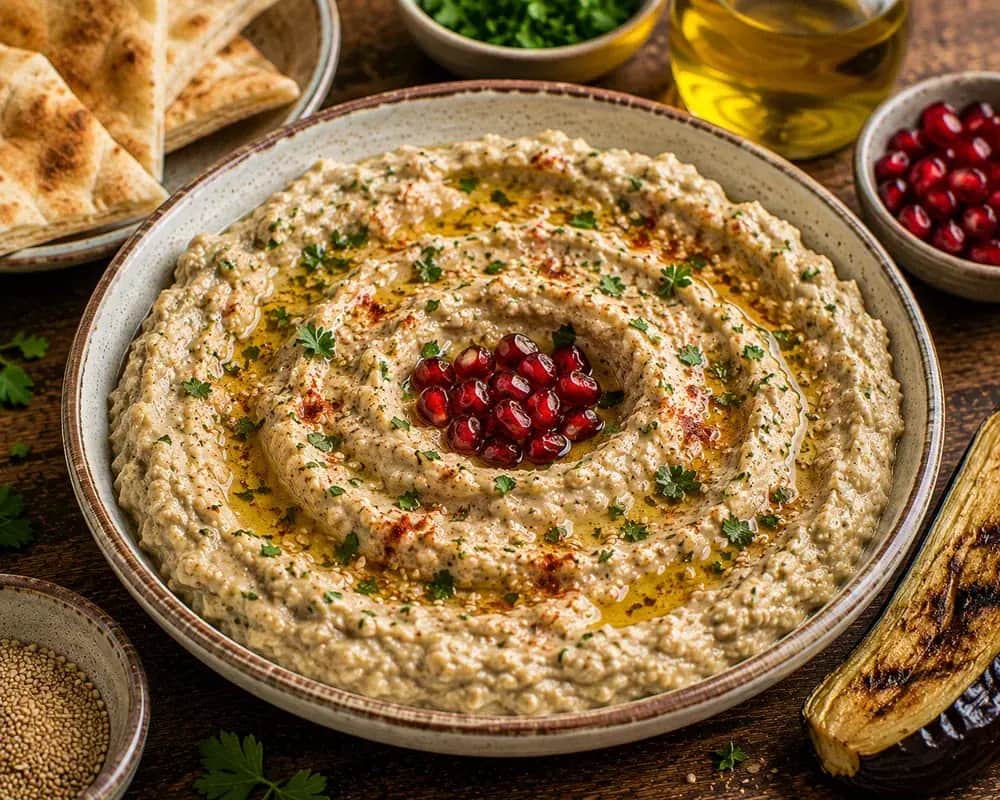
Classic Baba Ganoush Recipe
A classic Baba Ganoush recipe made with smoky roasted eggplant, tahini, garlic, fresh lemon juice, and extra virgin olive oil. This creamy Mediterranean mezze is rich, flavorful, and naturally plant-based.
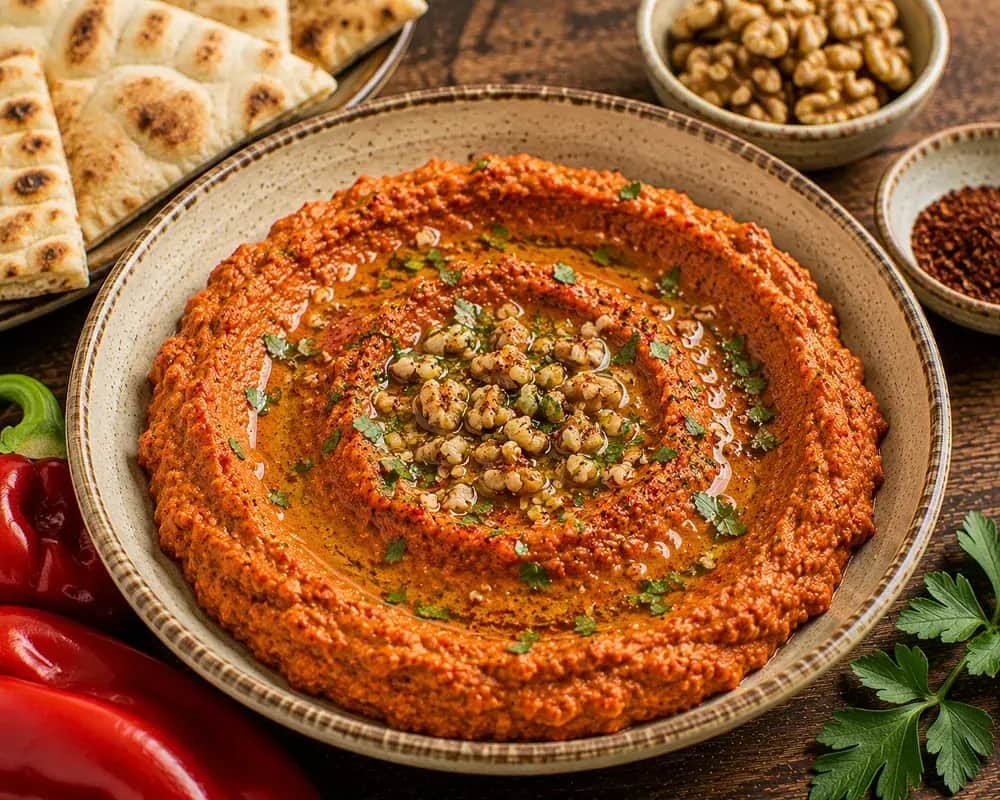
Muhammara Recipe — Aleppine Syrian Roasted Red Pepper & Walnut Dip
This Muhammara recipe is a traditional Aleppine Syrian roasted red pepper and walnut dip made with roasted red peppers, toasted walnuts, pomegranate molasses, extra virgin olive oil, garlic, cumin, and warm spices. Thick, smoky, sweet-tart, and richly textured, this easy Levantine mezze is perfect with warm pita, vegetables, and other shared dishes.
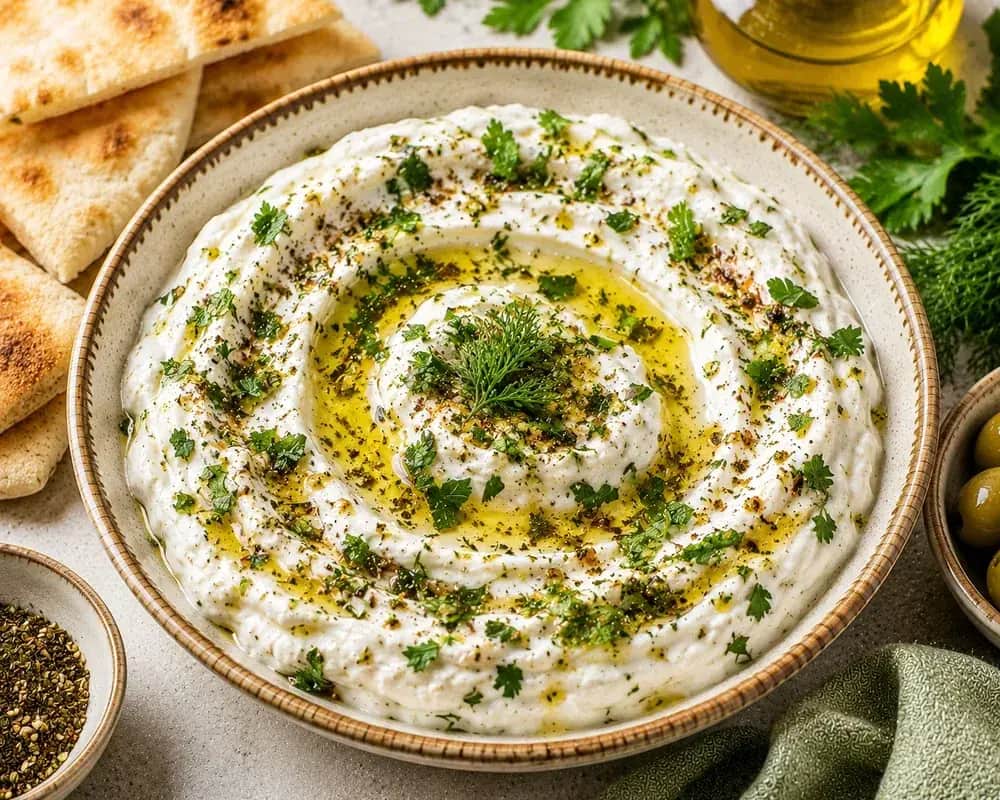
Herbed Labneh Dip Recipe — Lebanese Labneh with Fresh Herbs & Za'atar
A creamy labneh dip seasoned with fresh herbs, olive oil, garlic, and Mediterranean spices. Strained yogurt gives labneh its thick texture and tangy flavor, making it easy to spread across warm pita or serve as part of a mezze table.