
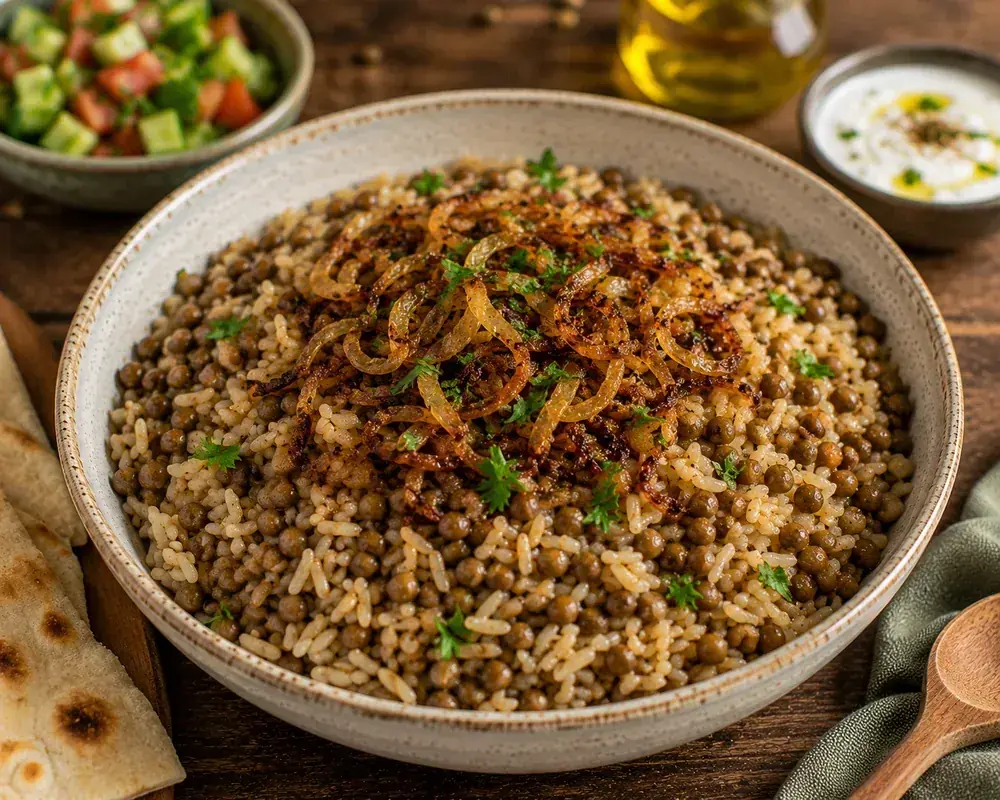
Lebanese Mujadara Recipe — Lentils, Rice & Caramelized Onions
This Lebanese Mujadara recipe combines tender brown lentils, fluffy long-grain rice, deeply caramelized onions, cumin, coriander, extra virgin olive oil, fresh parsley, and lemon. A simple Lebanese and Levantine comfort food that is naturally vegan, vegetarian, plant-based, and packed with protein and fiber.
Prep Time
15 mins
Cook Time
55 mins
Total Time
70 mins
Servings
6
A TASTE OF TRADITION
The Story Behind This Recipe
Mujadara is the kind of food that shows how a handful of inexpensive ingredients can become something deeply comforting. A pot of lentils, rice, and onions does not sound elaborate, but give the onions enough time to turn deeply golden and sweet, season the lentils properly, and the result becomes rich, aromatic, and satisfying. It is the sort of dish that feels equally at home on a family dinner table, packed into a lunch container, or served generously from a large platter for everyone to share.
Cultural & Culinary Context
Mujadara is strongly associated with the Levant, including Lebanon, Syria, Palestine, and Jordan, and appears in many regional forms. The name and exact preparation vary from place to place, and versions may use different grains, lentils, spices, or onion preparations. Rather than belonging to one single fixed recipe, Mujadara represents a broader tradition of cooking humble pantry ingredients into nourishing everyday food. In Lebanese home cooking, the combination of lentils, grains, onions, olive oil, and warm spices reflects the practical and generous character of many traditional plant-based dishes.
What Makes It Mediterranean?
This Lebanese-style Mujadara fits naturally within the wider Mediterranean and Levantine food tradition through its use of olive oil, legumes, grains, herbs, and fresh lemon. It relies on vegetables, pulses, and grains rather than heavy sauces, while the caramelized onions provide most of the dish's richness. Fresh parsley and lemon are especially useful at the table because they bring brightness to the earthy lentils and sweet onions.
Mediterranean Influences
- 🌿Extra virgin olive oil forms the main cooking fat.
- 🌿Lentils provide an important plant-based protein and fiber source.
- 🌿Rice supplies the grain component of the meal.
- 🌿Onions are slowly cooked until naturally sweet and deeply flavorful.
- 🌿Cumin and coriander provide warm, aromatic seasoning.
- 🌿Fresh parsley adds a bright herbal finish.
- 🌿Fresh lemon balances the earthy lentils and caramelized onions.
- 🌿The dish is naturally plant-based and does not depend on meat or cream for richness.
Ingredients
- 1 cup brown lentils (Rinsed and checked for stones or debris. Cook until nearly tender, but do not let them become soft or fall apart.)
- 1 cup long-grain rice (Rinse several times under cold water until the water is mostly clear, then drain thoroughly.)
- 3 large yellow onions (Slice thinly and as evenly as possible so the onions caramelize at a similar rate.)
- 3 tbsp extra virgin olive oil (Used primarily to slowly caramelize the onions and build the main flavor of the dish.)
- 1 tsp ground cumin (Adds warm, earthy depth and complements the lentils.)
- 0.5 tsp ground coriander (Adds a gentle earthy and citrus-like note.)
- 1 tsp sea salt (Start here and adjust after cooking because different vegetable broths contain different amounts of salt.)
- 0.5 tsp freshly ground black pepper
- 2.5 cups vegetable broth (Use hot broth when possible. The exact liquid requirement can vary slightly with the rice and how thoroughly it was drained.)
- 1 fresh parsley (Chopped and added just before serving for freshness and color.)
- 1 lemon (Cut into wedges for serving. Fresh lemon helps brighten the earthy lentils and sweet onions.)
Instructions
- 1
Rinse the lentils thoroughly and pick through them for any small stones or debris. Place them in a saucepan with plenty of water and bring to a gentle boil.
- 2
Cook the lentils for about 15–20 minutes, or until they are nearly tender but still hold their shape. They should be easy to bite through but should not be soft enough to fall apart. Drain them well.
- 3
While the lentils cook, rinse the rice under cold water several times until the water becomes mostly clear. Drain thoroughly. Removing excess surface starch helps the finished rice remain lighter and more separate.
- 4
Heat the olive oil in a large, heavy-bottomed pot or deep skillet over medium heat. Add the sliced onions and begin cooking them slowly.
- 5
Cook the onions for about 25–35 minutes, stirring regularly. Continue until they become deeply golden brown, soft, and sweet. If they brown too quickly or begin sticking, lower the heat and add a small splash of water to loosen the pan.
- 6
Remove about half of the caramelized onions and reserve them for the final topping. Keep the remaining onions in the cooking pot.
- 7
Add the cumin, coriander, salt, and black pepper to the remaining onions. Stir for about 30 seconds until the spices become fragrant. Do not let the spices burn.
- 8
Add the drained rice and nearly tender lentils. Stir gently for about 1 minute so the grains and lentils become coated with the seasoned onions and spices.
- 9
Pour in the hot vegetable broth and stir once to distribute everything evenly. Bring the liquid to a gentle boil.
- 10
Reduce the heat to low, cover the pot tightly, and simmer for about 18–20 minutes, or until the rice is tender and the liquid has been absorbed. Avoid repeatedly opening the lid because escaping steam can interfere with even cooking.
- 11
Turn off the heat and leave the pot covered for 10 minutes. The trapped steam will finish cooking the rice and allow the grains to settle.
- 12
Remove the lid and gently fluff the Mujadara with a fork. Avoid vigorous stirring because it can break the lentils and rice and turn the dish heavy or mushy.
- 13
Taste the Mujadara and adjust salt and pepper if needed. If the flavor feels particularly earthy or heavy, a small squeeze of fresh lemon can brighten the dish.
- 14
Transfer the Mujadara to a serving platter or serve directly from the pot. Scatter the reserved caramelized onions and chopped parsley over the top.
- 15
Serve warm or at room temperature with lemon wedges, fresh vegetables, cucumber salad, or another light accompaniment.
SET YOURSELF UP FOR SUCCESS
Before You Cook
👨🍳 Keep In Mind
- •Rinse and inspect the lentils before cooking. Small stones or debris can occasionally be present in dried legumes.
- •Rinse the rice several times and drain it well. Excess surface starch and excess water can both contribute to a heavier final texture.
- •Slice the onions before starting. The caramelization stage requires attention, so having everything ready makes the process easier.
- •Use a heavy-bottomed pot or deep skillet that distributes heat evenly.
- •Have a small amount of water nearby in case the onions begin sticking before they are fully caramelized.
- •Measure the spices and broth before the onions are finished so you can move smoothly into the rice-and-lentil stage.
- •Use hot broth if possible. Adding very cold liquid can temporarily stop the simmer and lengthen the cooking process.
💡 Helpful Tips
- •The onions are the main flavor-building step. Do not rush them by using very high heat.
- •Deep golden brown is desirable; blackened or bitter onions are not.
- •If onions are browning unevenly, stir and reduce the heat rather than simply cooking faster.
- •The lentils should be nearly tender before joining the rice. If they are already completely soft, they are more likely to break during the second cooking stage.
- •Do not repeatedly lift the lid while the rice cooks. Steam is part of the cooking process.
- •Once the broth is added, stir only enough to distribute the ingredients evenly. Excess stirring can make the final dish heavier.
- •Let the finished Mujadara rest covered before fluffing. This is particularly helpful when the rice looks slightly moist immediately after cooking.
- •Use a fork rather than a spoon for fluffing to reduce crushing the rice and lentils.
- •Keep some caramelized onions separate for the top. Their concentrated sweetness gives the finished dish a strong contrast in texture and flavor.
- •Taste after resting, not only before cooking, because the rice and lentils absorb seasoning as they cook.
👀 How Do I Know It's Done?
- ✓The lentils are tender but still hold their shape.
- ✓The rice is fully tender without a hard center.
- ✓The broth has been absorbed rather than remaining pooled underneath.
- ✓The grains look relatively separate rather than forming a wet mass.
- ✓The lentils remain intact instead of turning into a paste.
- ✓The caramelized onions are deeply golden brown and soft with a sweet, savory aroma.
- ✓The final dish tastes seasoned throughout rather than only on the surface.
- ✓The Mujadara becomes easier to fluff after its 10-minute covered rest.
Tweak It
Make This Recipe Work for You
Adapt the recipe to your ingredients, dietary needs, budget, time, serving size, or meal-prep plans.
🔄 Ingredient Substitutions
Using another type of lentil
Green or other firm-cooking lentils can sometimes be used, but cooking times vary. Choose lentils that hold their shape and adjust the pre-cooking time rather than relying strictly on the stated minutes.
Using another long-grain rice
Different long-grain rice varieties absorb liquid differently. If you change the rice, use its normal cooking behavior as a guide and watch the liquid level carefully.
Using water instead of vegetable broth
Water works if broth is unavailable. Because it provides less seasoning, taste the dish carefully and adjust the salt and spices before serving.
Adjusting the spices
Increase cumin for a warmer, earthier flavor or slightly increase coriander for a brighter aromatic note. Add changes gradually because the flavor becomes more concentrated as the liquid is absorbed.
🌱 Dietary Adjustments
Vegan
The recipe is naturally vegan as written. Use vegetable broth and check packaged ingredients if following a strict vegan diet.
Vegetarian
The recipe is naturally vegetarian and does not require dairy, eggs, or meat.
Gluten-free
Rice and lentils are naturally gluten-free, but packaged broth and spice blends should be checked for gluten-containing ingredients or cross-contact if needed.
Lower-sodium
Use a low-sodium vegetable broth and reduce the added salt. Taste after the rice and lentils have finished cooking before adding more seasoning.
💰 Budget-Friendly Options
Keep the pantry-friendly ingredients
Mujadara is naturally economical because its main ingredients are dried lentils, rice, onions, spices, and oil. There is no need for expensive specialty ingredients to create a flavorful meal.
Do not cut back too far on onions
The caramelized onions provide much of the dish's character. If onions are inexpensive where you live, keeping the full amount is one of the best ways to add flavor without adding costly ingredients.
⏱️ Time-Saving Options
Slice the onions ahead
The onions can be sliced earlier in the day and kept refrigerated in a covered container. This makes the cooking session easier and lets you focus on caramelization.
Rinse the rice ahead
The rice can be rinsed and thoroughly drained shortly before cooking. Keep it covered if it will sit for a while so it does not dry out or collect debris.
Pre-measure the spices
Combine the cumin, coriander, salt, and pepper in a small bowl before cooking. This prevents the onions from overcooking while you measure ingredients.
👨👩👧👦 Serving Adjustments
Making a smaller batch
For two to three people, reduce the ingredients proportionally and use a smaller heavy-bottomed pot. The rice should still have enough room to cook evenly without being packed into a very deep layer.
Making a larger batch
For a crowd, use a wide heavy pot rather than an extremely deep narrow one. A very deep pot can make it harder for the rice to cook evenly.
🥡 Meal Prep
Prepare the Mujadara ahead
Mujadara works very well for meal prep. Cook the full recipe, cool it promptly, and portion it into airtight containers. Keep fresh parsley, lemon, and extra caramelized onions separate when possible.
Reheat without drying it out
Reheat gently in a covered pan or microwave. If the rice has dried during refrigeration, add a small splash of water before reheating and cover it so the steam can soften the grains.
RECIPE RESCUE
🧩 What Do You Need Help With?
Choose the problem you're facing and get a recipe-specific solution instead of a generic cooking tip.
WHAT IF?
🔄 What If...?
Choose your situation and we'll show you a practical pathway for making this recipe work.
STORAGE & LEFTOVERS
🥡 Storage & Leftovers
Allow cooked Mujadara to cool promptly rather than leaving it at room temperature for an extended period.
Transfer leftovers to shallow airtight containers so they cool and refrigerate efficiently.
Keep fresh parsley and lemon separate when possible so they remain fresh.
For best texture, reheat only the portion you plan to eat.
If the rice becomes dry after refrigeration, add a small splash of water before reheating and cover the container or pan to create steam.
Reheat gently rather than repeatedly boiling the Mujadara, which can make the rice softer and heavier.
If you prepared extra caramelized onions, store them separately when possible so they retain more of their texture.
Best Storage Time
For best quality, refrigerated cooked Mujadara is generally best used within 3–4 days when cooled and stored properly.
How to Store
Use shallow airtight food-safe containers for refrigeration. Keeping portions separate makes reheating easier and helps preserve the texture.
SERVING & PAIRING
🍽️ Serving & Pairing
Mujadara can be served warm or at room temperature. Spoon it onto a wide serving platter, scatter the reserved caramelized onions over the top, and finish with fresh parsley and lemon wedges. The earthy lentils, fluffy rice, and sweet onions pair especially well with cool, fresh accompaniments that provide moisture and acidity.
What Goes Well With It?
RECIPE FAQ
❓ Frequently Asked Questions
How do you make Lebanese Mujadara?
To make Lebanese Mujadara, first rinse 1 cup of brown lentils and simmer them for about 15–20 minutes until nearly tender but still intact, then drain them well. Rinse 1 cup of long-grain rice several times until the water is mostly clear and drain thoroughly. Meanwhile, slowly cook 3 thinly sliced large yellow onions in 3 tablespoons of extra virgin olive oil over medium heat for about 25–35 minutes until deeply golden, soft, and sweet. Reserve about half of the caramelized onions for topping. Season the remaining onions with 1 teaspoon ground cumin, 1/2 teaspoon ground coriander, 1 teaspoon sea salt, and 1/2 teaspoon freshly ground black pepper. Add the drained rice and nearly tender lentils and gently stir for about 1 minute. Pour in 2 1/2 cups hot vegetable broth, bring to a gentle boil, then cover and simmer over low heat for about 18–20 minutes until the rice is tender and the liquid is absorbed. Turn off the heat and leave the pot covered for 10 minutes. Finally, gently fluff the Mujadara with a fork and serve topped with the reserved caramelized onions, fresh parsley, and lemon wedges. It can be served warm or at room temperature with cucumber salad, fresh vegetables, yogurt, olives, or warm flatbread.
Why is my Mujadara mushy?
The most common causes are overcooked lentils, too much liquid, repeatedly opening and closing the lid, or vigorous stirring after cooking. Cook the lentils only until nearly tender before combining them with the rice, measure the broth carefully, keep the lid closed during simmering, and fluff gently with a fork after the resting period.
How soft should the lentils be before adding the rice?
They should be nearly tender but still hold their shape. You should be able to bite through one easily, but it should not collapse when pressed. The lentils still have to cook with the rice, so fully soft lentils are more likely to break apart.
Why are my onions burning instead of caramelizing?
The heat is probably too high or the onions are not being stirred often enough. Caramelization takes patience. Lower the heat, stir regularly, and if the pan becomes dry and the onions are sticking before they are tender, add a small splash of water to loosen the pan.
How do I know when the onions are properly caramelized?
They should be very soft, deeply golden to brown, glossy, and smell sweet and savory. Dark brown is desirable; black, dry, or bitter-smelling pieces indicate burning.
Can I use canned lentils?
Freshly cooked dried lentils are easier to control for this recipe because you can stop them at the nearly-tender stage. If using canned lentils, drain and rinse them well and add them later in the process so they do not become overly soft.
Can I use water instead of vegetable broth?
Yes. Water works, but the dish will have less savory depth. Taste the finished Mujadara carefully and adjust the salt and spices, then use lemon and caramelized onions to provide additional contrast.
Should I wash the rice before cooking Mujadara?
Yes. Rinse the rice several times until the water is mostly clear, then drain it thoroughly. This removes excess surface starch and helps the finished grains remain lighter and more separate.
Why is my rice still hard when the liquid is gone?
The pot may have lost too much steam, the rice may require slightly more liquid, or the lid may not have sealed well. Add a small splash of hot water or broth, cover tightly, cook over very low heat for several more minutes, and then let the pot rest covered.
Can I use brown rice?
You can, but brown rice generally requires a different amount of liquid and a longer cooking time than long-grain white rice. Because the lentils are already cooking separately, changing the rice may require adjusting the overall method to prevent the lentils from becoming too soft.
Is Mujadara traditionally vegan?
Many versions of Mujadara are naturally plant-based, relying on lentils, grains, onions, olive oil, and spices. Regional recipes vary, so accompaniments can differ. This version is vegan as written.
Is Mujadara Lebanese or Palestinian?
Mujadara is strongly associated with the Levant and appears in different forms across Lebanon, Syria, Palestine, Jordan, and neighboring food traditions. There is no need to force it into a single fixed national recipe; regional variations are part of what makes the dish so enduring.
Can I make Mujadara ahead of time?
Yes. It is an excellent meal-prep dish. Cook it fully, cool it promptly, and refrigerate it in airtight containers. Reheat gently with a small splash of water if needed, then refresh it with lemon, parsley, and caramelized onions.
Why does my Mujadara taste bland?
Because the ingredients are simple, seasoning and onion caramelization are especially important. Taste after cooking and add salt if needed, then use fresh lemon and generous caramelized onions to brighten the earthy lentils. Fresh parsley also makes a noticeable difference.
Can I freeze Mujadara?
It can be frozen, although the rice may become somewhat softer after thawing and reheating. Cool it promptly, portion it into airtight freezer-safe containers, thaw it safely, and reheat gently with a small splash of water.
What should I serve with Mujadara?
Fresh cucumber and tomato salad, cucumber yogurt, plain yogurt, lemon wedges, fresh herbs, olives, pickled vegetables, or warm flatbread all work well. The best accompaniments are usually fresh and acidic because they balance the earthy lentils and sweet caramelized onions.
Explore More
Go deeper into the cuisine
Learn more about the ingredients, traditions, and cooking approaches connected to this recipe.
Related from Healthy Mezze
You May Also Like
More delicious recipes from the Main Dishes
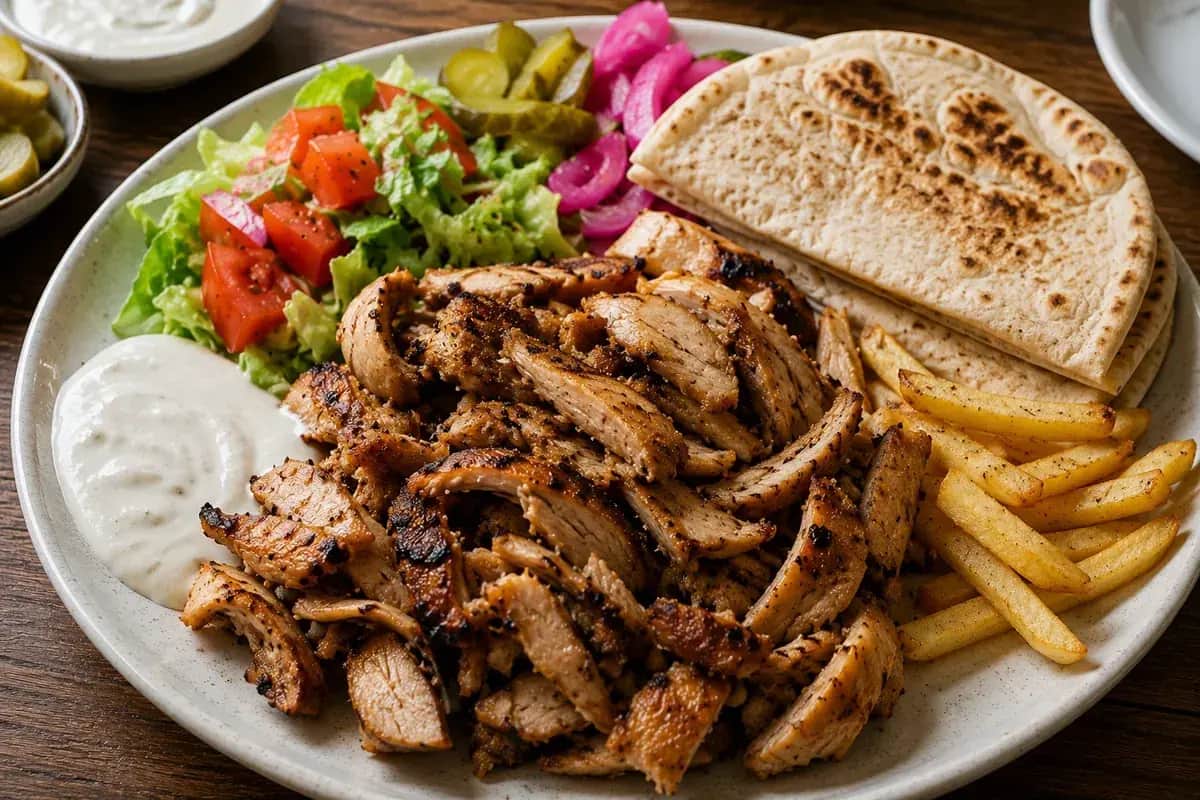
Palestinian Chicken Shawarma Recipe
A Palestinian chicken shawarma recipe made with thinly sliced chicken, yogurt, lemon, extra virgin olive oil, garlic, and warm Levantine spices. This homemade skillet version develops deeply browned edges while keeping the chicken tender and well seasoned. Serve it in warm pita, wraps, or a shawarma bowl with your favorite toppings.
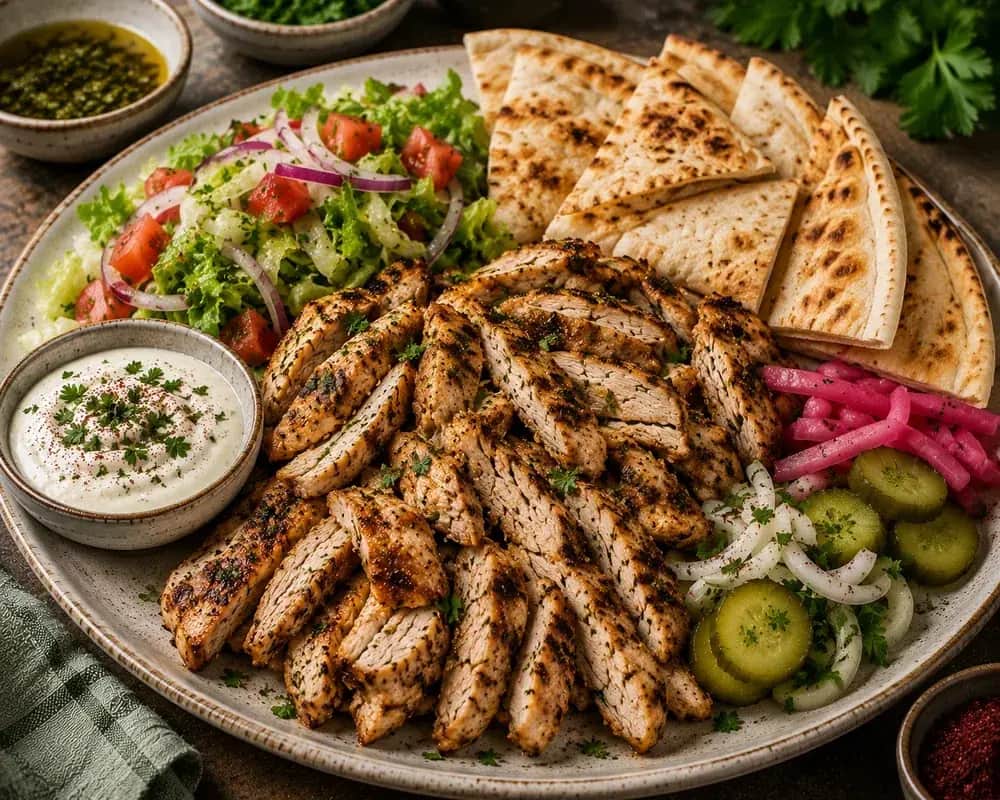
Grilled Chicken Shawarma Recipe — Lebanese-Style Mediterranean Chicken
A Lebanese-style grilled chicken shawarma made with thinly sliced chicken, yogurt, lemon, garlic, olive oil, and warm Levantine spices. The chicken develops lightly charred edges while staying tender, making it easy to serve in pita, wraps, bowls, salads, or as part of a mezze spread.
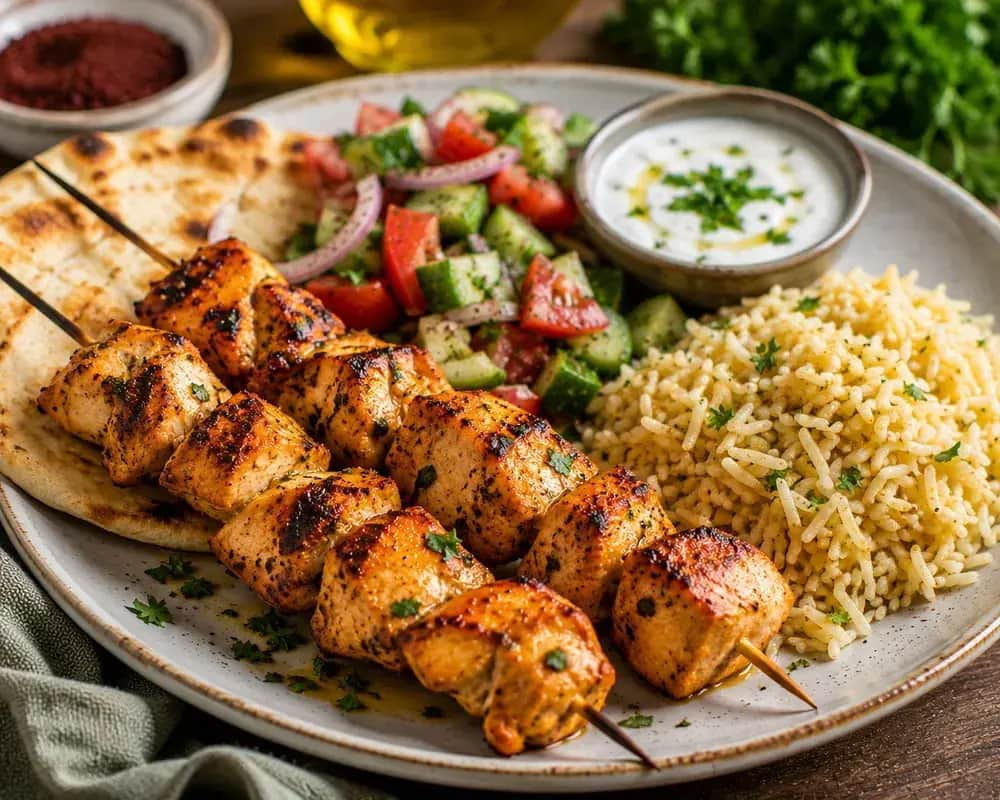
Shish Tawook Recipe — Juicy Lebanese Chicken Kabobs with Yogurt Marinade
This Shish Tawook recipe makes juicy Lebanese-style chicken kabobs marinated in Greek yogurt, lemon, garlic, extra virgin olive oil, tomato paste, paprika, cumin, oregano, and turmeric, then grilled until tender with golden-brown and lightly charred edges. An easy Mediterranean chicken recipe that's high in protein and perfect with toum, warm pita, rice, grilled vegetables, pickles, or fresh salad.