
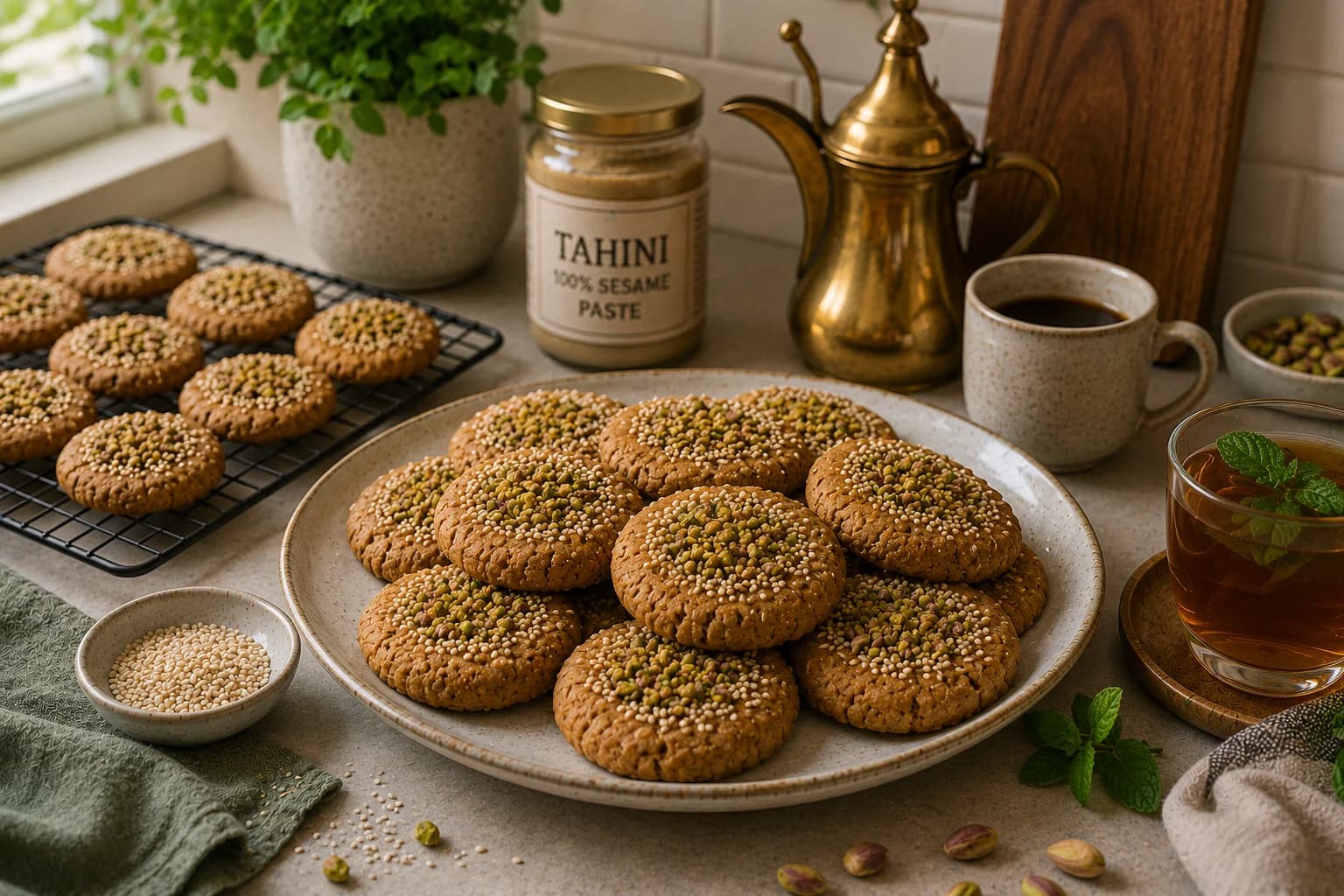
Healthy Sesame Tahini Cookies Recipe — Whole Wheat Tahini Cookies with Honey & Sesame
This healthy sesame tahini cookies recipe makes soft, lightly crisp whole-wheat cookies with sesame-rich tahini, honey, extra virgin olive oil, cinnamon, and toasted sesame seeds. An easy Mediterranean-inspired dessert with tender centers and lightly golden edges, perfect with Arabic coffee, black tea, or mint tea.
Prep Time
15 mins
Cook Time
12–15 mins
Total Time
1230 mins
Servings
18
A TASTE OF TRADITION
The Story Behind This Recipe
Tahini is one of the defining sesame ingredients of the Eastern Mediterranean and Middle East. Made from ground sesame seeds, it appears in both savory and sweet preparations and has long been valued for its rich flavor and creamy texture. Tahini-based sweets are especially familiar across the Levant and Egypt, where sesame, honey or sugar, nuts, and warm spices frequently meet in desserts and baked treats. These Healthy Sesame Tahini Cookies take that familiar flavor combination and turn it into a simple homemade cookie using whole-wheat flour, olive oil, honey, and toasted sesame seeds.
Cultural & Culinary Context
There is no single universally documented origin for the modern tahini cookie, and similar sesame-based cookies appear across several countries and culinary traditions. What is consistent is the importance of sesame and tahini in the food cultures of Egypt and the Levant. Tahini itself has a long history in the region and is used in dishes ranging from sauces and dips to sweets and pastries. Cookies made with tahini vary from place to place: some are richer and sweeter, some are crumbly, and others are shaped or decorated with sesame seeds or nuts. Rather than assigning this particular modern healthy recipe to one historical inventor, it is more useful to understand it as a contemporary interpretation of a much older regional love of sesame.
What Makes It Mediterranean?
The recipe brings together several ingredients strongly associated with Mediterranean and Middle Eastern cooking: sesame tahini, olive oil, whole grains, honey, cinnamon, and nuts. Sesame gives the cookies their distinctive earthy richness, while olive oil adds a gentle fruitiness and keeps the recipe free of butter. Cinnamon supplies warmth, and sesame seeds and pistachios add both texture and visual character. The result is a modern cookie that uses traditional regional flavors in a lighter format.
Mediterranean Influences
- 🌿Tahini is made from ground sesame seeds and is a fundamental ingredient in many Middle Eastern and Eastern Mediterranean kitchens.
- 🌿Extra virgin olive oil is used as the principal added fat instead of butter.
- 🌿Sesame seeds reinforce the deep sesame flavor already present in the tahini.
- 🌿Honey provides sweetness and connects the recipe with long-standing regional sweetening traditions.
- 🌿Cinnamon adds the warm aromatic character common in many Mediterranean and Middle Eastern sweets.
- 🌿Pistachios provide an optional nutty garnish familiar in regional desserts.
- 🌿Whole wheat flour gives the cookies a rustic, wholesome character while keeping the flavor compatible with traditional ingredients.
Ingredients
- 1.5 cups whole wheat flour (Spoon the flour into the measuring cup and level it rather than packing it down. Too much flour can make the cookies dry.)
- 1 tsp baking powder (Use fresh baking powder for reliable lift and a tender texture.)
- 0.25 tsp sea salt (Balances the sweetness and intensifies the sesame flavor.)
- 0.3333333333333333 cup tahini (Stir the tahini thoroughly before measuring. Use smooth, pourable tahini rather than thick, dry paste.)
- 2 tbsp extra virgin olive oil (A mild or medium-fruity olive oil works best so it complements the tahini rather than dominating it.)
- 3 tbsp honey (Use fluid honey. If crystallized, warm it gently until pourable before measuring.)
- 1 large egg (Room-temperature egg combines more easily with the tahini, oil, and honey.)
- 1 tsp vanilla extract (Adds aromatic depth and balances the sesame flavor.)
- 2 tbsp toasted sesame seeds (Use 1 tablespoon inside the dough and reserve 1 tablespoon for the tops.)
- 1 tbsp chopped pistachios (Optional. Use unsalted or lightly salted pistachios and chop them finely.)
- 1 tsp ground cinnamon (Adds warm aromatic depth without making the cookies heavily spiced.)
Instructions
- 1
Preheat the oven to 350°F (175°C) with a rack positioned in the center. Line a large baking tray with parchment paper.
- 2
If your sesame seeds are not already toasted, place 2 tablespoons in a dry skillet over low to medium-low heat. Stir frequently for several minutes until they become lightly golden and fragrant. Transfer them immediately to a plate so they stop cooking, then allow them to cool.
- 3
In a medium bowl, whisk together 1 1/2 cups whole wheat flour, 1 teaspoon baking powder, 1 teaspoon ground cinnamon, and 1/4 teaspoon sea salt. Mix thoroughly so the baking powder and cinnamon are evenly distributed.
- 4
In a separate bowl, whisk 1/3 cup tahini, 2 tablespoons extra virgin olive oil, 3 tablespoons honey, 1 large egg, and 1 teaspoon vanilla extract until smooth and uniform. Make sure the tahini has been thoroughly stirred before measuring so you do not accidentally use mostly sesame oil or mostly thick sesame paste.
- 5
Add the dry ingredients to the wet mixture in two additions. Stir gently with a spatula just until the flour is incorporated. Do not knead or aggressively mix the dough because overmixing can make whole-wheat cookies tougher.
- 6
Fold 1 tablespoon of the toasted sesame seeds into the dough, keeping the remaining 1 tablespoon for the cookie tops. The finished dough should be soft, cohesive, and easy to shape. It should not flow like batter.
- 7
Let the dough stand for 2–3 minutes. If it is still unusually sticky and cannot be rolled, add whole wheat flour 1 teaspoon at a time, mixing gently after each addition. Stop as soon as the dough becomes workable. Avoid adding large amounts of flour because this is the easiest way to produce dry cookies.
- 8
If the dough is crumbly and breaks apart when you try to roll it, add 1 teaspoon tahini at a time and mix gently until the dough holds together. Different tahini brands contain different amounts of oil, so small adjustments can occasionally be necessary.
- 9
Divide the dough into 18 approximately equal portions. Roll each portion gently between your palms into a ball and place them on the prepared tray, leaving approximately 1 1/2 inches (4 cm) between cookies.
- 10
Flatten each ball gently with your palm or the flat bottom of a glass until the cookies are approximately 1/2 inch (1–1.5 cm) thick. Do not flatten them extremely thin because the intended result is a tender center.
- 11
Sprinkle the remaining 1 tablespoon toasted sesame seeds over the cookies. If using the optional 1 tablespoon chopped pistachios, distribute them over the tops and press very lightly so they adhere.
- 12
Bake at 350°F (175°C) for 12–15 minutes. Begin checking at 12 minutes. The edges should be lightly golden and set while the centers should still appear slightly soft. Do not wait for the entire cookie to become dark brown.
- 13
Remove the tray from the oven and leave the cookies on the baking tray for 5 minutes. They will continue to set from the residual heat and are delicate immediately after baking.
- 14
Transfer the cookies carefully to a wire rack and allow them to cool completely. The edges will become slightly crisper while the centers remain tender.
- 15
Serve at room temperature with Arabic coffee, black tea, mint tea, or another beverage of your choice.
SET YOURSELF UP FOR SUCCESS
Before You Cook
👨🍳 Keep In Mind
- •Measure all ingredients before mixing. The dough comes together quickly once the wet and dry mixtures meet.
- •Stir the tahini thoroughly before measuring. Natural sesame oil often separates and rises to the surface during storage.
- •Use a kitchen scale if available when making the 18 cookies. Equal portions bake more evenly and make the stated serving size more reliable.
- •Make sure the toasted sesame seeds have cooled before adding them to the dough. Hot seeds can warm the dough and affect its consistency.
- •Use parchment paper or a silicone baking liner so the cookies release easily after baking.
- •Use a light-colored baking tray if possible. Very dark trays can brown the bottoms more quickly.
- •Have a wire rack ready because the cookies are fragile immediately after baking.
💡 Helpful Tips
- •Do not pack the whole wheat flour into the measuring cup. Excess flour is one of the most common reasons tahini cookies become dry.
- •Tahini brands vary in thickness. A smooth, pourable tahini generally produces easier-to-shape dough than very thick tahini.
- •If your tahini has separated heavily, stir the entire jar thoroughly before measuring rather than taking only the oil from the surface.
- •Do not overmix once the flour is incorporated. Stir only until the dough comes together.
- •Give the dough 2–3 minutes to settle before making adjustments. Whole wheat flour continues absorbing moisture after mixing.
- •Add extra flour only 1 teaspoon at a time. It is much easier to correct slightly sticky dough than to rescue dough that has become excessively dry.
- •If the dough is crumbly, add tahini rather than immediately adding another egg. Small amounts of tahini provide moisture and reinforce the sesame flavor without dramatically changing the structure.
- •Flatten the cookies evenly. Cookies of very different thicknesses will finish at different times.
- •Start checking at 12 minutes. Tahini cookies can look soft when they first come from the oven but continue setting on the tray.
- •Do not judge doneness by waiting for the centers to become completely firm. That usually means the cookies will be overbaked once cooled.
- •Allow the cookies to rest on the tray for 5 minutes before moving them. This prevents freshly baked cookies from breaking.
- •If making a second tray, keep the remaining dough at room temperature rather than refrigerating it for a long period, unless the dough becomes unusually soft.
👀 How Do I Know It's Done?
- ✓The dough has no visible dry pockets of flour before shaping.
- ✓The shaped cookies hold their form on the tray instead of spreading into thin puddles.
- ✓At around 12–15 minutes, the edges are lightly golden and visibly set.
- ✓The centers look slightly soft but are not wet or shiny like raw dough.
- ✓The bottoms are lightly colored rather than dark brown or burned.
- ✓After the 5-minute tray rest, the cookies can be lifted carefully without collapsing.
- ✓After complete cooling, the cookies are tender in the center with a lightly crisp edge.
Tweak It
Make This Recipe Work for You
Adapt the recipe to your ingredients, dietary needs, budget, time, serving size, or meal-prep plans.
🔄 Ingredient Substitutions
Using a different tahini
Tahini thickness varies considerably between brands. If the dough is too sticky, add whole wheat flour 1 teaspoon at a time. If it is crumbly, add tahini 1 teaspoon at a time.
Using olive oil with a stronger flavor
A strongly peppery or bitter extra virgin olive oil can dominate the cookies. A mild or medium-fruity olive oil gives a more balanced result.
Make them nut-free
Simply omit the optional 1 tablespoon chopped pistachios. The cookies will still bake successfully because the pistachios are only a topping.
Use sesame seeds without pistachios
The recipe already contains tahini and toasted sesame seeds, so omitting pistachios preserves the characteristic sesame flavor completely.
🌱 Dietary Adjustments
Vegetarian
The recipe contains no meat, poultry, or fish and is suitable for a vegetarian diet.
Vegan adaptation
The canonical recipe contains an egg and honey, so it is not vegan. A vegan adaptation would require replacing both ingredients with suitable alternatives, and the texture may change.
Nut-free option
Omit the optional pistachios. Check packaged tahini and sesame products for cross-contact if preparing the cookies for someone with a serious allergy.
💰 Budget-Friendly Options
Skip the pistachios
The 1 tablespoon pistachios is optional and mainly contributes color, texture, and garnish. Leaving it out does not affect the basic cookie structure.
Use pre-toasted sesame seeds
Pre-toasted sesame seeds can save time and eliminate the separate skillet-toasting step. Make sure they are unsalted if possible.
⏱️ Time-Saving Options
Toast sesame seeds ahead
Toast the 2 tablespoons sesame seeds in advance and store them once completely cool. Use 1 tablespoon in the dough and reserve 1 tablespoon for the tops.
Prepare the ingredients first
Measure 1 1/2 cups flour, 1 teaspoon baking powder, 1/4 teaspoon salt, 1/3 cup tahini, 2 tablespoons olive oil, 3 tablespoons honey, 1 egg, 1 teaspoon vanilla, and 1 teaspoon cinnamon before beginning.
👨👩👧👦 Serving Adjustments
18 moderate cookies
The recipe is designed to make approximately 18 cookies. Divide the dough evenly so the cookies finish baking at approximately the same time.
Make smaller cookies
You can divide the dough into smaller portions for bite-sized cookies, but begin checking them earlier because thinner or smaller cookies bake faster.
🥡 Meal Prep
Make ahead
The baked cookies can be prepared ahead and stored in an airtight container once completely cool. Their texture is best when protected from humidity.
Prepare the dough shortly before baking
For the most predictable texture, shape and bake the dough soon after mixing. Whole wheat flour continues absorbing moisture over time, which can make the dough firmer.
RECIPE RESCUE
🧩 What Do You Need Help With?
Choose the problem you're facing and get a recipe-specific solution instead of a generic cooking tip.
WHAT IF?
🔄 What If...?
Choose your situation and we'll show you a practical pathway for making this recipe work.
STORAGE & LEFTOVERS
🥡 Storage & Leftovers
Allow the cookies to cool completely before storing them. Trapping warm cookies in a container creates condensation and can soften the edges.
Store the cooled cookies in an airtight container at room temperature.
Place parchment between layers if stacking the cookies to reduce sticking or damage to the sesame and pistachio topping.
Keep the container away from direct sunlight and excessive kitchen heat.
If the cookies become softer from humidity, briefly warming them can restore some surface crispness, but avoid overheating because it can dry the centers.
Best Storage Time
Best enjoyed within 3–4 days for the intended tender texture and fresh sesame aroma.
How to Store
Use a clean airtight container with parchment between layers if the cookies are stacked.
SERVING & PAIRING
🍽️ Serving & Pairing
Serve the cookies completely cooled at room temperature. Their sesame flavor pairs particularly well with unsweetened or lightly sweetened hot drinks. Arrange them on a simple serving plate and finish with a few extra sesame seeds or pistachios for a polished presentation.
What Goes Well With It?
RECIPE FAQ
❓ Frequently Asked Questions
How do you make healthy sesame tahini cookies?
To make healthy sesame tahini cookies, first toast 2 tablespoons sesame seeds if needed and allow them to cool. Whisk together 1 1/2 cups whole wheat flour, 1 teaspoon baking powder, 1 teaspoon cinnamon, and 1/4 teaspoon sea salt. In a separate bowl, whisk 1/3 cup well-stirred tahini, 2 tablespoons extra virgin olive oil, 3 tablespoons honey, 1 large egg, and 1 teaspoon vanilla until smooth. Combine the wet and dry mixtures gently, fold in 1 tablespoon toasted sesame seeds, and let the dough stand for 2–3 minutes. Shape the dough into 18 portions, flatten them to about 1/2 inch (1–1.5 cm) thick, and top with the remaining sesame seeds and optional chopped pistachios. Bake at 350°F (175°C) for 12–15 minutes until the edges are lightly golden and set while the centers remain slightly soft. Rest the cookies on the tray for 5 minutes, then transfer them to a wire rack to cool completely.
What are tahini cookies?
Tahini cookies are cookies made with sesame paste, giving them a distinctive nutty, earthy sesame flavor. Similar sesame-based cookies and sweets are found across the Middle East and Eastern Mediterranean, although recipes vary considerably between regions.
Are tahini cookies Lebanese?
Tahini and sesame sweets are strongly associated with Lebanese and broader Levantine cuisine, but tahini cookies are not exclusive to Lebanon. Similar preparations exist across the Middle East and Mediterranean region.
Are these cookies Egyptian?
The recipe uses ingredients and flavors familiar in Egyptian and Middle Eastern cooking, but the specific Healthy Mezze formula is a modern recipe rather than a claim to one historical Egyptian cookie recipe.
Why does my tahini need to be stirred before measuring?
Tahini naturally separates during storage, with sesame oil rising above the denser sesame solids. Stirring the tahini thoroughly ensures the measured 1/3 cup has a more consistent balance of oil and sesame paste.
Can I use white flour instead of whole wheat flour?
You can, but the texture and flavor will change. The canonical recipe uses whole wheat flour for its more substantial texture and higher fiber content.
Why are my cookies dry?
The most likely causes are too much flour, overbaking, or making the cookies too thin. Measure the flour carefully and remove the cookies when the edges are lightly golden while the centers remain slightly soft.
Why is my dough crumbly?
Thick tahini or excess flour can make the dough crumbly. Add tahini 1 teaspoon at a time until the dough becomes cohesive and can be rolled without falling apart.
Why is my dough sticky?
Very fluid tahini, warm ingredients, or excess moisture can make the dough sticky. Let it stand for 2–3 minutes first, then add whole wheat flour 1 teaspoon at a time only if necessary.
Should I refrigerate the cookie dough?
Refrigeration is not normally necessary for this recipe. For the most predictable texture, shape and bake the dough soon after mixing because whole wheat flour continues absorbing moisture.
Why did my cookies spread?
The dough may have been unusually soft because of very fluid tahini, warm ingredients, or excess moisture. Make sure the dough can hold its shape before baking and use a cool baking tray.
How thick should I make the cookies?
Aim for approximately 1/2 inch (1–1.5 cm) after flattening. This gives the cookies enough thickness to retain a tender center while allowing the edges to become lightly golden.
How do I know when tahini cookies are done?
The edges should be lightly golden and set, while the centers should still look slightly soft. The cookies should not be deeply brown across the entire surface. They continue setting during the 5-minute rest on the baking tray.
Why are my cookies soft when they come out of the oven?
That is expected. Freshly baked cookies continue cooking and setting from residual heat. Leave them on the tray for 5 minutes before transferring them to a rack.
Can I leave out the pistachios?
Yes. The 1 tablespoon chopped pistachios is optional and is used only as a garnish. The cookies will bake normally without them.
Can I leave out the sesame seeds?
The cookies can technically be made without the sesame seed topping, but the sesame seeds reinforce the tahini flavor and add texture. Tahini itself remains the main sesame ingredient.
Can I use another oil instead of olive oil?
You can use another mild cooking oil, but the flavor will change. Extra virgin olive oil is intentionally used in this recipe because it complements the sesame and gives the cookies a Mediterranean character.
Can I replace the honey?
A different liquid sweetener can be used, but it may change the sweetness, moisture, and browning of the cookies. Adjust cautiously rather than replacing the honey volume blindly.
Are these cookies vegan?
No. The canonical recipe contains one large egg and honey. A vegan adaptation would require replacing both ingredients and may produce a different texture.
Are these cookies vegetarian?
Yes. They contain no meat, poultry, or fish and are suitable for a vegetarian diet.
Can I make these cookies gluten-free?
The canonical recipe uses whole wheat flour and is therefore not gluten-free. A gluten-free flour blend may work, but it would require testing because flour blends absorb moisture differently.
Can I make smaller cookies?
Yes. Smaller cookies are possible, but begin checking them earlier because they will bake faster than the standard 18 cookies.
Why should I let the cookies cool on the tray?
The cookies are fragile immediately after baking. Five minutes on the tray allows the structure to set before they are moved to the wire rack.
How should I store tahini cookies?
Cool them completely and store them in an airtight container at room temperature. If stacking them, place parchment between the layers to protect the toppings.
How long do the cookies keep?
They are best enjoyed within 3–4 days when stored properly in an airtight container at room temperature.
Can I freeze tahini cookies?
They can be frozen, but the texture may change slightly after thawing. For the best texture and sesame aroma, fresh room-temperature storage is preferred for the short term.
What should the finished cookie taste like?
The finished cookie should taste distinctly of sesame and tahini, with gentle sweetness from honey, warm cinnamon, a subtle olive-oil character, and a lightly toasted nutty finish.
Explore More
Go deeper into the cuisine
Learn more about the ingredients, traditions, and cooking approaches connected to this recipe.
You May Also Like
More delicious recipes from the Desserts
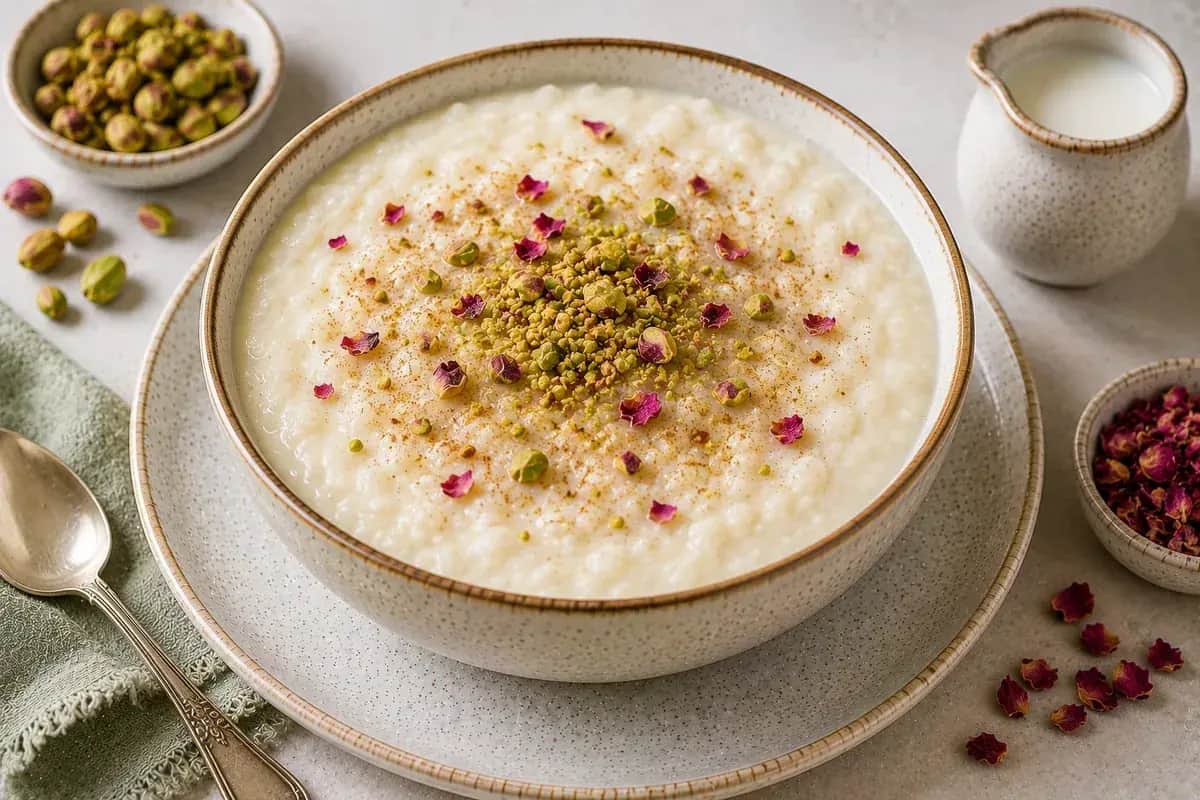
Healthy Roz Bel Laban Recipe — Egyptian Rice Pudding with Pistachios & Almonds
An Egyptian rice pudding made with milk, rice, gentle sweetness, cinnamon, and a nutty finish. Slow cooking gives the rice a creamy texture while keeping the dessert simple enough for everyday serving or make-ahead preparation.
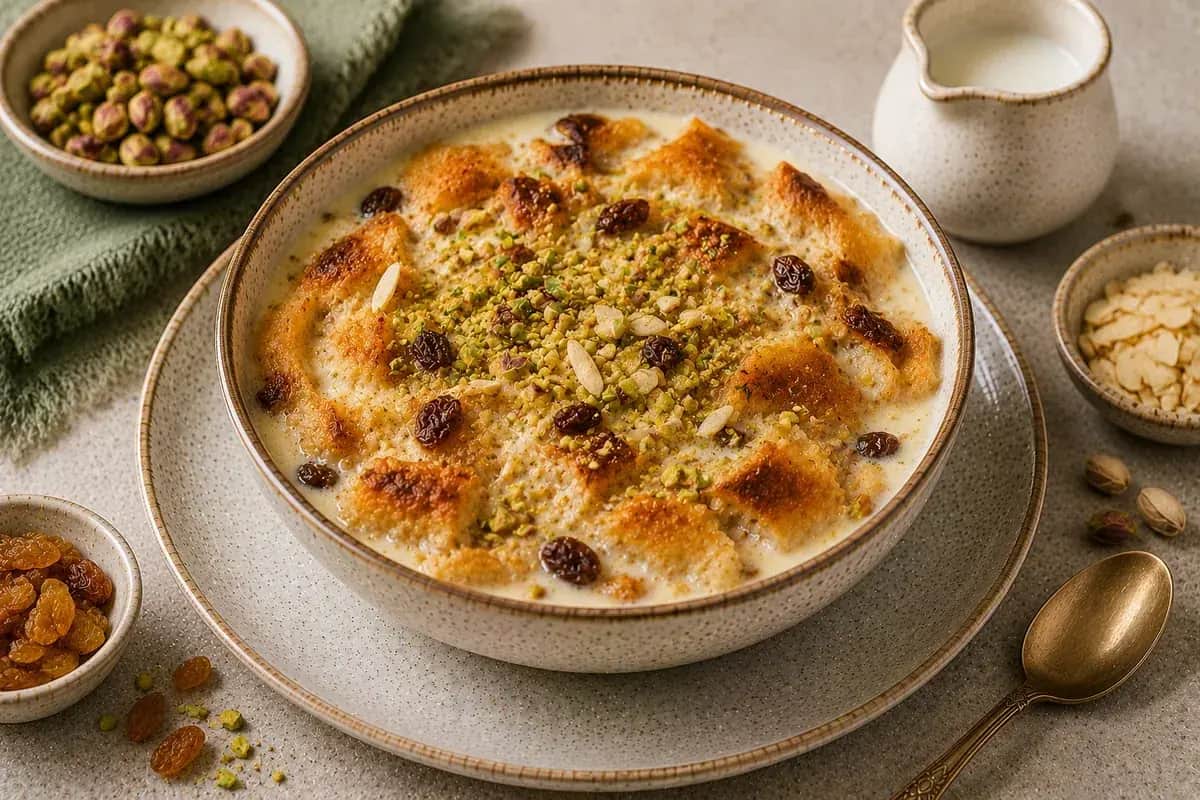
Healthy Om Ali Recipe — Egyptian Bread Pudding with Dates & Nuts
An Egyptian Om Ali made with baked pastry, milk, dried fruit, nuts, and warm spices. The pastry absorbs the sweetened milk as it bakes, creating a soft center with toasted edges and a nutty finish.
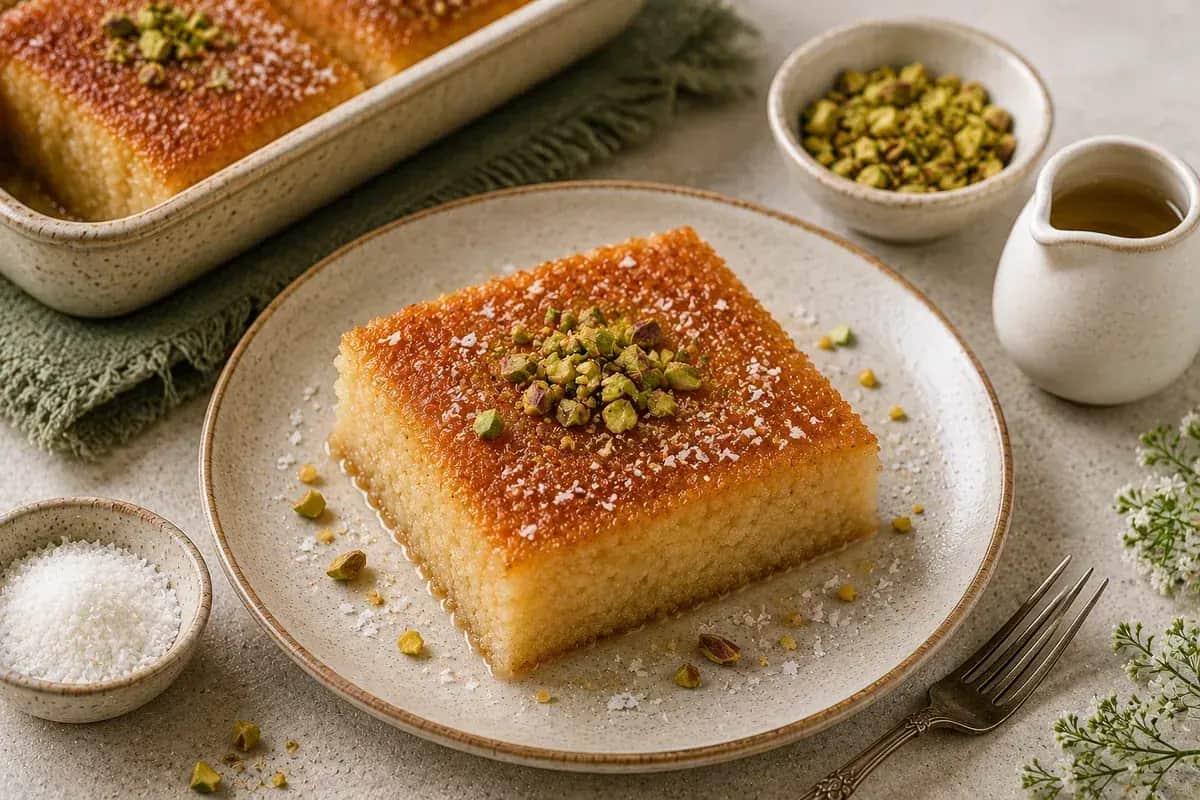
Healthy Basbousa Recipe — Light Egyptian Semolina Cake with Honey & Almonds
A lighter Egyptian basbousa made with semolina, yogurt, coconut, almonds, and a measured syrup. The cake bakes until golden and tender, then absorbs just enough syrup to give it the characteristic moist texture without becoming overly sweet.