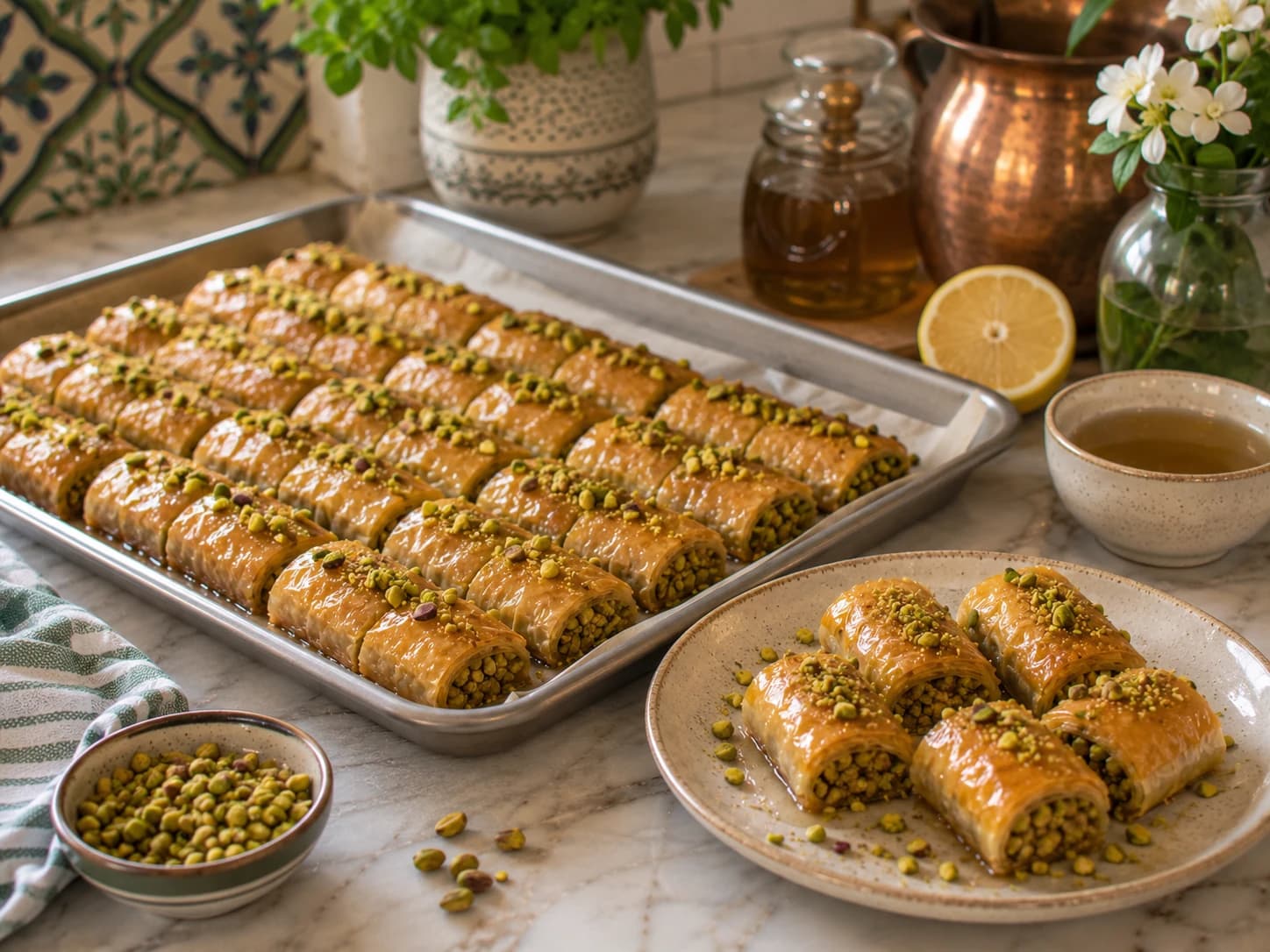
Healthy Pistachio Baklava Rolls Recipe — Whole Wheat Phyllo with Honey & Nuts
Crisp pistachio baklava rolls made with thin pastry, a generous nut filling, and a light honey-orange blossom syrup. The rolls bake until golden and flaky, giving the dessert a delicate crunch with fragrant citrus notes.
Prep Time
30 mins
Cook Time
30 mins
Total Time
60 mins
Servings
16
A TASTE OF TRADITION
The Story Behind This Recipe
Baklava is one of the best-known pastries of the Eastern Mediterranean and Middle East, celebrated for its thin layers of pastry, aromatic nuts, and fragrant syrup. These pistachio baklava rolls take that familiar combination and present it in a simpler rolled format. Instead of relying on a heavy butter coating and a thick sugar syrup, this version uses extra virgin olive oil and a restrained honey-lemon-orange blossom syrup. The result is still recognizably baklava: crisp pastry, fragrant nuts, warm spices, and floral sweetness, but with a lighter overall profile.
Cultural & Culinary Context
Baklava has a long and complex culinary history shared across the Eastern Mediterranean, the Middle East, and neighboring regions. It is associated with many cuisines, including Lebanese, Syrian, Palestinian, Egyptian, Turkish, Greek, and other regional traditions, with different communities developing their own shapes, fillings, spices, and syrup styles. Because of this wide geographic history, there is no single universally accepted origin story for modern baklava. Pistachios, walnuts, phyllo-like layered pastry, aromatic spices, and sweet syrups have all played important roles in the region's dessert traditions for generations. These rolls are inspired by that broader tradition rather than claiming one exclusive historical origin.
What Makes It Mediterranean?
The recipe brings together several ingredients strongly associated with Mediterranean and Middle Eastern cooking: extra virgin olive oil, pistachios, walnuts, lemon, honey, cinnamon, cardamom, and orange blossom water. These ingredients create the characteristic balance of toasted nuts, warm spice, citrus brightness, and floral aroma found in many regional desserts. Using olive oil instead of butter also connects the pastry to the wider Mediterranean preference for olive oil as a foundational cooking fat.
Mediterranean Influences
- 🌿Extra virgin olive oil is a defining ingredient of Mediterranean cooking and replaces butter as the main pastry fat in this lighter version.
- 🌿Pistachios and walnuts are widely used in Mediterranean and Middle Eastern pastries and sweets.
- 🌿Honey provides natural sweetness and has a long history in regional dessert traditions.
- 🌿Lemon adds acidity that balances the sweetness and keeps the flavor bright.
- 🌿Cinnamon and cardamom provide warm aromatic notes commonly found in Middle Eastern sweets.
- 🌿Orange blossom water contributes the delicate floral aroma associated with many Levantine and broader Middle Eastern desserts.
Ingredients
- 12 sheets whole wheat phyllo pastry (Thaw completely according to the package directions. Keep the sheets covered with a clean, slightly damp kitchen towel while assembling so they do not dry out or crack.)
- 1/3 cup extra virgin olive oil (Use for lightly brushing the phyllo. Brush thinly and evenly rather than saturating the pastry. You may not need every drop.)
- 1 cup finely chopped pistachios (Unsalted or lightly salted pistachios work best. Chop them finely enough to distribute easily without turning them into a paste.)
- 1/2 cup finely chopped walnuts (Chop to approximately the same size as the pistachios so the filling distributes evenly.)
- 1 tsp ground cinnamon (Adds warm sweetness and depth without requiring additional sugar.)
- 1/4 tsp ground cardamom (A small amount provides a strong floral, warm aroma. Avoid adding much more because cardamom can quickly dominate the filling.)
- 3 tbsp honey (Forms the base of the lighter syrup. The quantity is deliberately modest compared with many traditional baklava syrups.)
- 3 tbsp water (Thins the honey so it can spread through the baked rolls without creating an excessively thick syrup.)
- 1 tsp fresh lemon juice (Balances the honey's sweetness and gives the syrup a clean finish.)
- 1 tsp orange blossom water (Add after removing the syrup from the heat so its delicate floral aroma is retained.)
- 1 extra chopped pistachios for garnish (Optional finishing garnish. Sprinkle over the rolls after the syrup has been added.)
Instructions
- 1
Thaw the 12 sheets of whole wheat phyllo completely according to the package directions before beginning. Keep the pastry covered with a clean, slightly damp kitchen towel while you work, exposing only the sheets you are using. Phyllo dries quickly when exposed to air and can crack when rolled.
- 2
Preheat the oven to 350°F (175°C). Line a baking tray with parchment paper. Place your olive oil, pastry brush, nut filling, knife, and baking tray within easy reach before opening the phyllo so the sheets spend as little time exposed as possible.
- 3
Combine 1 cup finely chopped pistachios, 1/2 cup finely chopped walnuts, 1 teaspoon ground cinnamon, and 1/4 teaspoon ground cardamom in a bowl. Stir thoroughly so the cinnamon and cardamom are evenly distributed throughout the nuts.
- 4
Place 1 sheet of phyllo on a clean, dry work surface and immediately cover the remaining sheets again. Lightly brush the entire sheet with extra virgin olive oil. Use a thin, even layer; too much oil can make the finished rolls greasy and harder to crisp.
- 5
Place a second phyllo sheet directly on top of the first and lightly brush its surface with olive oil. You now have one two-sheet pastry layer. Keep all unused phyllo covered.
- 6
Spread approximately 1/6 of the nut mixture in a thin line along one long edge of the two-sheet layer. Do not pile the filling too thickly or push it all the way to the edges, because excessive filling can make the roll difficult to close and cook unevenly.
- 7
Starting from the long edge containing the filling, roll the two phyllo sheets firmly into a compact log. Roll evenly without squeezing the filling out. Place the finished log seam-side down on the parchment-lined tray so it stays closed.
- 8
Repeat the two-sheet layering and rolling process with the remaining 10 sheets and the remaining filling. You should finish with 6 rolled logs. Keep unused pastry covered throughout the process and divide the filling as evenly as possible between the six rolls.
- 9
Lightly brush the exposed tops of all 6 rolls with some of the remaining olive oil. The goal is a thin coating that encourages even browning and crispness, not a heavy layer of oil.
- 10
Using a sharp knife, gently cut the 6 logs into approximately 16 individual portions before baking. Keep the pieces arranged seam-side down on the tray. Cutting before baking makes the crisp pastry much easier to portion after cooking.
- 11
Bake at 350°F (175°C) for approximately 25–30 minutes. If your oven browns unevenly, rotate the tray during baking. The rolls are ready when the phyllo is crisp, flaky, and evenly golden. Do not judge doneness by time alone because ovens and baking trays vary.
- 12
While the baklava is baking, combine 3 tablespoons honey and 3 tablespoons water in a small saucepan. Warm gently over low heat until the honey loosens and the mixture is hot and evenly combined. Do not aggressively boil the syrup; this recipe is intended to have a light, fluid syrup rather than a thick candy-like coating.
- 13
Remove the syrup from the heat and stir in 1 teaspoon fresh lemon juice and 1 teaspoon orange blossom water. Let the syrup cool while the baklava finishes baking. A cool or well-cooled syrup poured over hot pastry helps preserve a better crisp texture than using aggressively boiling syrup.
- 14
Remove the baked rolls from the oven when they are golden and crisp. Immediately spoon the cooling honey syrup slowly over the hot rolls, distributing it across the surface and into the spaces between the pieces. Do not pour all the syrup into one location.
- 15
Allow the baklava rolls to cool and settle for at least 30 minutes. During this time, the pastry absorbs some of the light syrup while retaining its crisp outer layers. Do not cover the rolls while they are still hot because trapped steam can soften the phyllo.
- 16
Finish with extra chopped pistachios just before serving. Serve at room temperature or slightly warm. Each portion should have crisp flaky pastry, a fragrant pistachio-walnut center, and just enough syrup to provide sweetness without making the pastry soggy.
SET YOURSELF UP FOR SUCCESS
Before You Cook
👨🍳 Keep In Mind
- •Thaw all 12 phyllo sheets completely according to the package instructions. Partially frozen phyllo is more likely to crack and tear when separated.
- •Prepare the nut filling before opening the pastry by combining 1 cup pistachios, 1/2 cup walnuts, 1 teaspoon cinnamon, and 1/4 teaspoon cardamom.
- •Measure the 1/3 cup olive oil and keep a pastry brush ready so each phyllo sheet can be brushed quickly.
- •Have a clean, slightly damp kitchen towel ready to cover the unused phyllo. The towel should be damp, not wet, because excess moisture can make the pastry sticky.
- •Line the baking tray with parchment before assembling the rolls.
- •Measure the syrup ingredients separately: 3 tablespoons honey, 3 tablespoons water, 1 teaspoon lemon juice, and 1 teaspoon orange blossom water.
- •Keep the sharp knife available before rolling. Cutting the logs before baking makes the finished baklava much easier to portion.
💡 Helpful Tips
- •Phyllo is delicate. Keep the unused sheets covered at all times and work with only the sheets needed for the current roll.
- •If a phyllo sheet develops a small tear, do not panic. A small tear can usually be covered by the second sheet in the pair. Avoid repeatedly handling the pastry because this creates more tears.
- •Brush the olive oil thinly and evenly. Excess oil can make the rolls greasy rather than crisp.
- •Divide the nut filling into roughly 6 equal portions before assembly if you want the six rolls to have very similar filling levels.
- •Roll the pastry firmly enough to create a compact log, but do not squeeze it so hard that the nuts are pushed out.
- •Always place the finished logs seam-side down. This helps prevent them from opening during baking.
- •Do not skip the 30-minute cooling period after adding the syrup. The pastry needs time to settle and absorb some of the syrup.
- •Do not cover the hot baklava. Steam trapped under a cover can soften the crisp phyllo.
- •If your pistachios are salted, avoid adding additional salt anywhere in the recipe.
- •Orange blossom water is concentrated. The measured 1 teaspoon is enough to give the syrup a noticeable floral aroma without overpowering the nuts.
👀 How Do I Know It's Done?
- ✓All 12 phyllo sheets have been fully baked into the finished rolls and the exterior is crisp.
- ✓The tops and visible sides are golden rather than pale.
- ✓The pastry flakes when gently touched or cut instead of remaining soft and doughy.
- ✓The nut filling is cooked and fragrant, with the pistachio and walnut mixture remaining distinct rather than wet.
- ✓The syrup has been absorbed partially without pooling heavily around the rolls.
- ✓After the 30-minute resting period, the baklava should hold its shape when lifted and should not collapse or feel waterlogged.
Tweak It
Make This Recipe Work for You
Adapt the recipe to your ingredients, dietary needs, budget, time, serving size, or meal-prep plans.
🔄 Ingredient Substitutions
Using regular phyllo
Whole wheat phyllo is specified for this recipe, but regular phyllo can be used if whole wheat phyllo is unavailable. The texture and fiber content will change, and the pastry may brown slightly differently.
Adjusting the nut balance
The intended filling uses 1 cup pistachios and 1/2 cup walnuts. Keeping this overall quantity helps maintain the correct filling-to-pastry ratio and makes the six rolls easier to assemble.
Keep the olive oil light
The 1/3 cup olive oil is a maximum working quantity rather than a requirement to use every drop. Brush the phyllo lightly and evenly and stop when the sheets are coated.
🌱 Dietary Adjustments
Vegetarian dessert
This recipe is vegetarian and contains no meat, poultry, or fish.
Vegan consideration
The recipe is not vegan because it uses honey. A vegan version would require replacing the honey with a suitable plant-based sweetener, which would change the syrup's flavor and character.
💰 Budget-Friendly Options
Make the pistachios go further
Finely chopping the 1 cup pistachios helps distribute their flavor throughout all 6 rolls without requiring a larger quantity. Keep the 1/2 cup walnuts in the mixture to add body and texture.
Skip extra garnish
The extra chopped pistachios are only a garnish. Omitting them does not affect the baking or syruping process.
⏱️ Time-Saving Options
Prepare the filling first
Mix the 1 cup pistachios, 1/2 cup walnuts, 1 teaspoon cinnamon, and 1/4 teaspoon cardamom before opening the phyllo. This reduces the time the delicate pastry remains uncovered.
Measure the syrup ingredients early
Measure the 3 tablespoons honey, 3 tablespoons water, 1 teaspoon lemon juice, and 1 teaspoon orange blossom water before the rolls go into the oven. The syrup can then be prepared quickly while the baklava bakes.
👨👩👧👦 Serving Adjustments
Makes approximately 16 portions
The recipe uses 12 sheets to create 6 rolled logs, which are cut into approximately 16 individual portions before baking. Cutting before baking produces cleaner portions after the pastry becomes crisp.
🥡 Meal Prep
Prepare components ahead
The nut mixture can be combined and the syrup ingredients can be measured ahead of time. Keep thawed phyllo covered and assemble the rolls close to baking so the pastry does not dry out.
Bake close to serving
For the crispest texture, bake and syrup the rolls reasonably close to serving. Humidity and prolonged storage naturally soften phyllo.
RECIPE RESCUE
🧩 What Do You Need Help With?
Choose the problem you're facing and get a recipe-specific solution instead of a generic cooking tip.
WHAT IF?
🔄 What If...?
Choose your situation and we'll show you a practical pathway for making this recipe work.
STORAGE & LEFTOVERS
🥡 Storage & Leftovers
Allow the baklava rolls to cool completely before storing them.
Place the rolls in a covered container, preferably arranged in a single layer so the delicate pastry is not crushed.
Avoid sealing the container while the baklava is still warm because trapped steam can soften the phyllo.
Keep the stored baklava in a cool, dry place for short-term storage if your environment is suitable, or refrigerate when necessary for food-safety conditions.
If refrigerated, allow the rolls to come closer to room temperature before serving because cold storage can make the pastry feel less crisp.
Do not add additional syrup after storage to compensate for softened pastry; excessive moisture can make the texture more soggy.
Best Storage Time
Best enjoyed within 2–3 days for the best balance of syrup absorption and pastry texture.
How to Store
Use a clean airtight or well-covered food-storage container, keeping the rolls protected from humidity and crushing.
SERVING & PAIRING
🍽️ Serving & Pairing
Serve the baklava rolls at room temperature or slightly warm after they have rested for at least 30 minutes. Arrange the approximately 16 pieces on a serving platter and finish with a small amount of chopped pistachios if desired. The best bite combines crisp phyllo, fragrant pistachios and walnuts, warm cinnamon and cardamom, and a light floral honey-lemon syrup.
What Goes Well With It?
RECIPE FAQ
❓ Frequently Asked Questions
How do you make healthy pistachio baklava rolls?
To make healthy pistachio baklava rolls, layer 12 sheets of whole wheat phyllo in pairs, lightly brushing each sheet with extra virgin olive oil. Mix 1 cup finely chopped pistachios with 1/2 cup walnuts, 1 teaspoon cinnamon, and 1/4 teaspoon cardamom, then divide the filling between 6 rolls. Roll the filled phyllo into compact logs, place them seam-side down, brush lightly with olive oil, and cut into approximately 16 portions before baking at 350°F (175°C) for 25–30 minutes. While the baklava bakes, gently warm 3 tablespoons honey with 3 tablespoons water, then add 1 teaspoon lemon juice and 1 teaspoon orange blossom water after removing the syrup from the heat. Spoon the cooling syrup over the hot golden rolls, let them cool uncovered for at least 30 minutes, and finish with chopped pistachios if desired.
What makes these baklava rolls healthier?
This version uses extra virgin olive oil instead of butter and a restrained honey-based syrup instead of a large quantity of refined sugar syrup. It also uses whole wheat phyllo when available and relies on pistachios, walnuts, spices, lemon, and orange blossom water for much of its flavor.
Is this traditional Lebanese baklava?
Baklava is shared across many Eastern Mediterranean and Middle Eastern cuisines, and there are many traditional regional versions. This version takes inspiration from that broader tradition, using the rolled pastry format and pistachio filling as a lighter interpretation rather than presenting them as the only traditional Lebanese combination.
Why are the phyllo sheets layered in pairs?
Using two lightly oiled sheets for each roll gives the pastry enough strength to hold the nut filling and form a compact log while still producing flaky layers after baking.
How many rolls does this recipe make?
The 12 phyllo sheets are paired to create 6 rolled logs. The logs are then cut into approximately 16 individual portions before baking.
How much nut filling goes into each roll?
The filling contains 1 cup pistachios, 1/2 cup walnuts, 1 teaspoon cinnamon, and 1/4 teaspoon cardamom. Dividing the mixture into approximately 6 equal portions gives each roll about 1/6 of the total filling.
Why do I need to keep the phyllo covered?
Phyllo dries rapidly when exposed to air. Dry pastry becomes brittle and can crack when brushed, filled, or rolled. Keeping unused sheets covered helps maintain enough flexibility to work with them.
Can I use butter instead of olive oil?
The canonical Healthy Mezze recipe specifically uses 1/3 cup extra virgin olive oil. Butter would change both the flavor and nutritional profile, so it is not the intended preparation for this lighter version.
Why is there no traditional heavy sugar syrup?
This recipe is designed as a lighter baklava. Instead of a large quantity of sugar syrup, it uses 3 tablespoons honey, 3 tablespoons water, 1 teaspoon lemon juice, and 1 teaspoon orange blossom water to provide a lighter coating.
Should the syrup be boiling when I add it?
No. Warm the honey and water gently, then remove the syrup from the heat and add the lemon juice and orange blossom water. Allow the syrup to cool while the baklava bakes, then spoon it over the hot rolls. This helps avoid unnecessarily saturating the crisp phyllo with aggressively boiling syrup.
Why do I pour syrup over hot baklava?
Hot baked pastry is ready to absorb some of the light syrup immediately. The syrup should be cooling rather than aggressively boiling, allowing the rolls to absorb flavor while retaining more of their crisp structure.
Why should I wait 30 minutes before serving?
The resting period allows the syrup to distribute and absorb, while the pastry cools enough to become easier to handle. Covering the rolls during this time can trap steam and soften the phyllo.
How do I know the baklava is fully baked?
The phyllo should be crisp, flaky, and evenly golden. If the pastry is still pale or flexible, continue baking carefully. Oven performance varies, so the appearance and texture are more reliable than the exact 25–30-minute time range.
Why did my baklava become soggy?
Common causes include adding too much syrup, not baking the phyllo until crisp, allowing the syrup to pool in one area, or covering the rolls while they are still hot. Use the measured syrup, bake until golden and crisp, distribute the syrup evenly, and leave the rolls uncovered while cooling.
Can I prepare the filling ahead?
Yes. The pistachios, walnuts, cinnamon, and cardamom can be mixed ahead of time. Keep the prepared filling covered until you are ready to assemble the rolls.
Can I make the syrup ahead?
Yes. The syrup ingredients can be measured ahead, and the honey-water mixture can be prepared before the pastry finishes baking. Keep it ready for use once the baklava comes out of the oven.
Can I use regular phyllo instead of whole wheat?
Yes. Regular phyllo can be substituted if whole wheat phyllo is unavailable. The finished dessert will have a different nutritional profile and slightly different pastry flavor, but the same rolling and baking method can be used.
Is this recipe vegetarian?
Yes. The recipe contains no meat, poultry, or fish and is therefore vegetarian.
Is this recipe vegan?
No. It contains honey. A vegan version would require a plant-based sweetener and would therefore have a somewhat different syrup flavor.
Can I refrigerate leftover baklava?
Yes. Allow the rolls to cool completely and store them covered. Refrigeration can soften the phyllo, so bring the baklava closer to room temperature before serving when appropriate.
How long does the baklava keep?
For the best texture, enjoy it within 2–3 days. Protect it from humidity and avoid storing it while warm.
Can I freeze the finished baklava?
Freezing is not the preferred storage method for this recipe because the thawing process can significantly affect the crisp phyllo texture. For the best result, prepare an amount that can be enjoyed within a few days.
Explore More
Go deeper into the cuisine
Learn more about the ingredients, traditions, and cooking approaches connected to this recipe.
You May Also Like
More delicious recipes from the Desserts
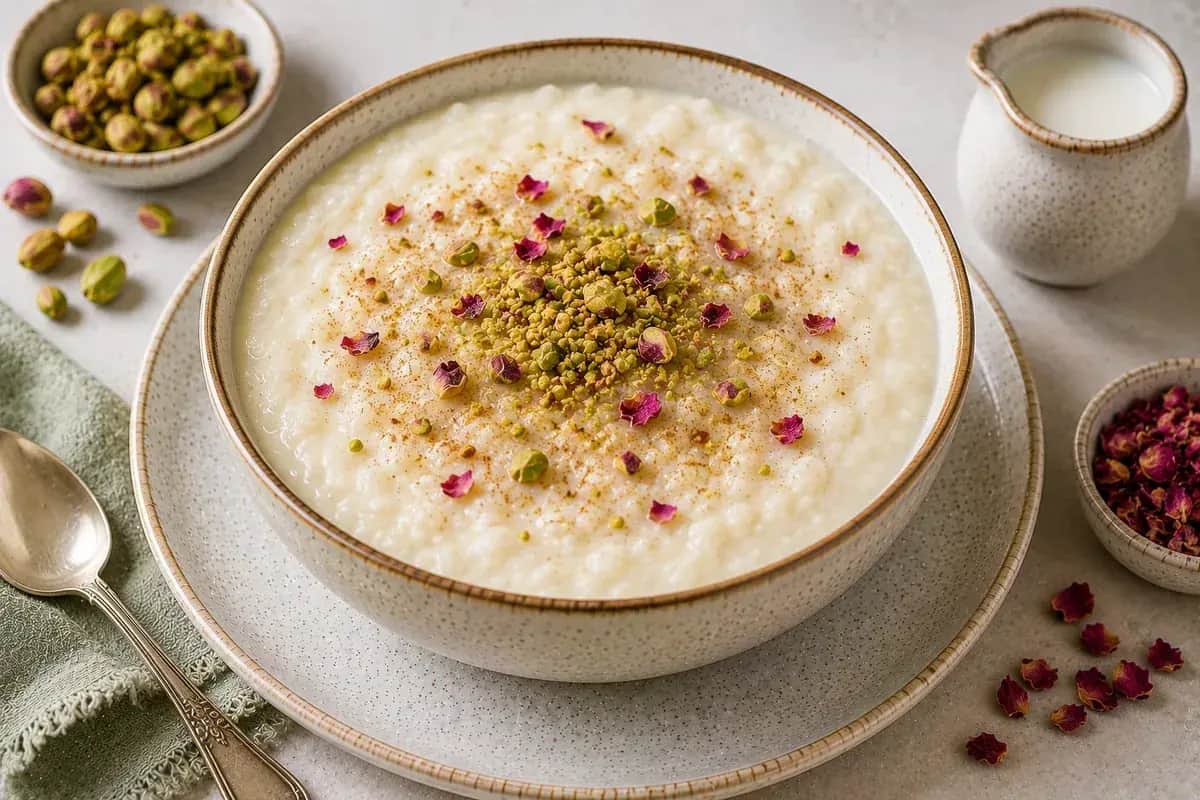
Healthy Roz Bel Laban Recipe — Egyptian Rice Pudding with Pistachios & Almonds
An Egyptian rice pudding made with milk, rice, gentle sweetness, cinnamon, and a nutty finish. Slow cooking gives the rice a creamy texture while keeping the dessert simple enough for everyday serving or make-ahead preparation.
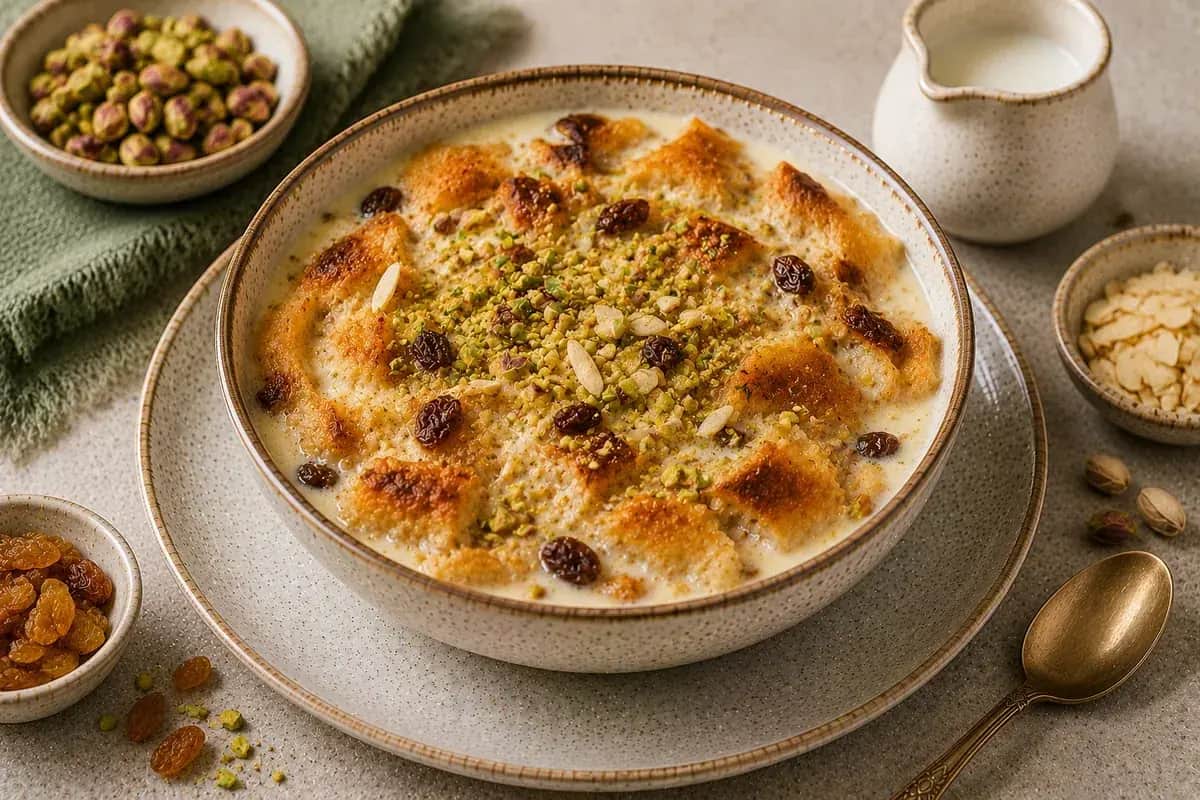
Healthy Om Ali Recipe — Egyptian Bread Pudding with Dates & Nuts
An Egyptian Om Ali made with baked pastry, milk, dried fruit, nuts, and warm spices. The pastry absorbs the sweetened milk as it bakes, creating a soft center with toasted edges and a nutty finish.
Healthy Basbousa Recipe — Light Egyptian Semolina Cake with Honey & Almonds
A lighter Egyptian basbousa made with semolina, yogurt, coconut, almonds, and a measured syrup. The cake bakes until golden and tender, then absorbs just enough syrup to give it the characteristic moist texture without becoming overly sweet.