
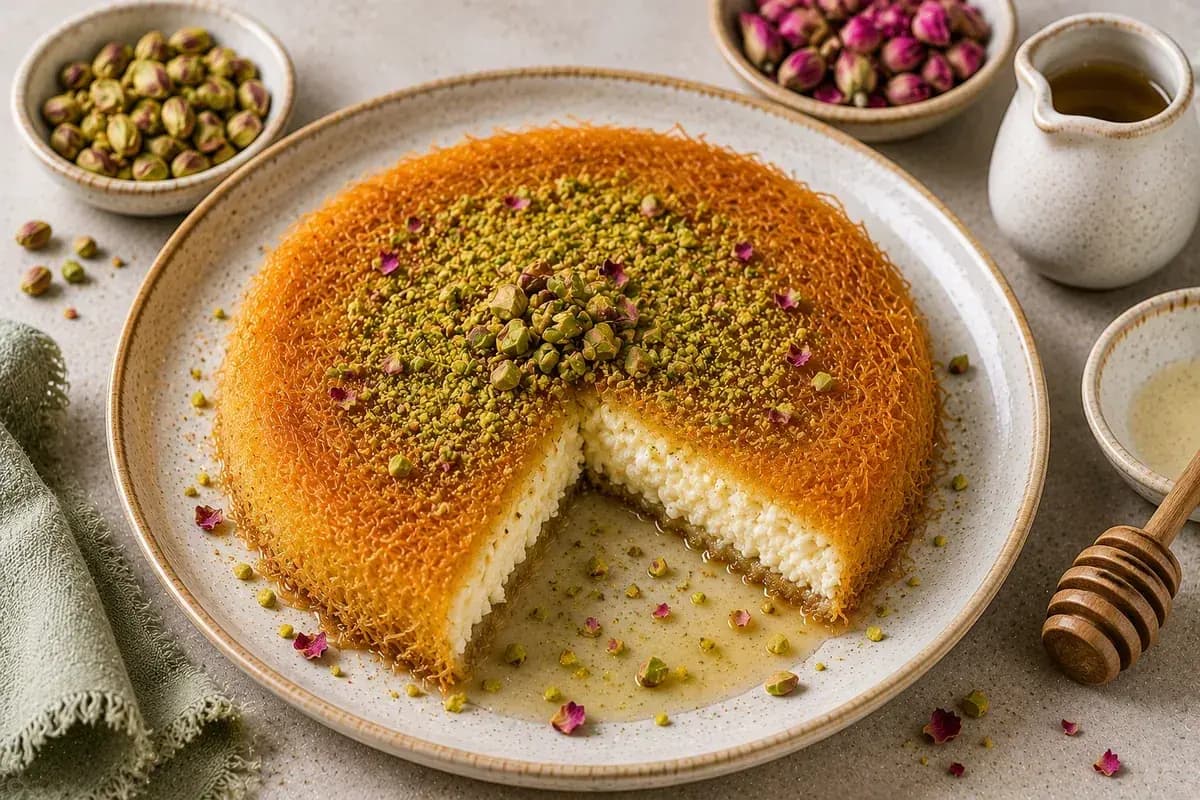
Healthy Kanafeh Recipe with Ricotta & Pistachios — Light Lebanese Kunafa
This healthy kanafeh recipe with ricotta and pistachios is a lighter Lebanese-inspired take on classic Middle Eastern kunafa, made with crisp golden kataifi pastry, creamy part-skim ricotta, reduced-fat mozzarella, pistachios, and a delicate honey-orange blossom syrup. A festive vegetarian dessert with less added sweetness and olive oil instead of a large amount of butter, while keeping the crisp pastry, creamy cheese filling, floral aroma, and pistachio finish that make kanafeh so special.
Prep Time
25 mins
Cook Time
35 mins
Total Time
60 mins
Servings
10
A TASTE OF TRADITION
The Story Behind This Recipe
Kanafeh is a celebrated Middle Eastern dessert built around one of the region's most appealing contrasts: delicate pastry becoming crisp and deeply golden around a soft, creamy cheese filling. The dessert is commonly associated with the Levant and is particularly prominent in Palestinian, Lebanese, Syrian, and Jordanian food traditions, while many related versions are enjoyed across the wider Middle East. Its exact ingredients, shape, cheese, sweetness, and finishing style vary from place to place, which is part of what makes kanafeh such a fascinating regional dessert. This Healthy Kanafeh with Ricotta & Pistachios takes inspiration from those traditions while adapting the preparation for a lighter homemade dessert.
Cultural & Culinary Context
Kanafeh has long been connected with hospitality, celebrations, family gatherings, religious and festive occasions, and busy sweet shops throughout the Levant. One of the best-known traditions is cheese-filled kanafeh, where a crisp kataifi or semolina-based exterior surrounds a warm, soft cheese center and the finished dessert is scented and sweetened with syrup before being decorated with pistachios. Regional recipes differ considerably: some use specific local cheeses, some use semolina-based crusts, and others emphasize different syrup aromas or textures. Rather than claiming one recipe represents all kanafeh traditions, this version celebrates the shared idea of crisp pastry, creamy cheese, floral aroma, light syrup, and pistachio garnish.
What Makes It Mediterranean?
The recipe reflects Eastern Mediterranean food culture through its combination of wheat-based pastry, dairy, olive oil, pistachios, citrus, and orange blossom water. Olive oil is used as the main fat for the pastry, while pistachios and aromatic floral water provide familiar regional flavors. The use of ricotta is an intentional adaptation rather than a claim that ricotta is the traditional cheese used in every regional kanafeh. It provides a practical, widely available creamy filling while allowing the recipe to retain the warm cheese-centered character of the dessert.
Mediterranean Influences
- 🌿Olive oil is used to coat and crisp the kataifi pastry, connecting the recipe with the importance of olive oil in Eastern Mediterranean cooking.
- 🌿Pistachios are a classic garnish for many Middle Eastern sweets and provide color, crunch, and a distinctive nutty flavor.
- 🌿Orange blossom water contributes a floral aroma strongly associated with Levantine and Middle Eastern desserts.
- 🌿Wheat-based kataifi pastry reflects the long-standing importance of grains and wheat in regional baking.
- 🌿Cheese-filled sweets are an established part of Levantine dessert culture, especially in festive and celebratory settings.
- 🌿Fresh lemon juice balances the sweetness of the honey syrup and adds a bright citrus note.
- 🌿The combination of crisp pastry, creamy dairy, floral aroma, nuts, and light syrup captures the sensory character of Eastern Mediterranean sweets.
Ingredients
- 12 oz (340 g) kataifi pastry, thawed (Thaw completely before using. Kataifi dries quickly once exposed to air, so keep unused pastry covered with a clean slightly damp kitchen towel while assembling.)
- 0.25 cup extra virgin olive oil (A mild or fruity olive oil works best. The goal is to coat the strands evenly rather than leave them heavily saturated.)
- 1.5 cups part-skim ricotta cheese (Drain watery ricotta in a fine-mesh sieve for 15–30 minutes. Removing excess liquid is important because a wet filling can make the pastry soft and prevent the center from setting properly.)
- 0.5 cup reduced-fat shredded mozzarella (Finely shred the mozzarella so it melts evenly through the ricotta instead of forming large pockets.)
- 1 tsp vanilla extract (Adds a gentle sweetness and rounds out the floral orange blossom aroma.)
- 1 tsp orange blossom water (Use culinary-grade orange blossom water. Its flavor is concentrated, so the measured teaspoon gives fragrance without overpowering the cheese.)
- 1 tbsp finely chopped pistachios (Use as a fresh finishing garnish. Finely chopping them makes it easier to distribute a small amount across all 10 servings.)
- 1 For the syrup: (Prepare the syrup while the kanafeh is baking so it is warm and ready when the dessert comes out of the oven.)
- 3 tbsp honey (Provides the main sweetness for the light syrup. Use a mild honey so it does not overpower the orange blossom.)
- 3 tbsp water (Thins the honey into a pourable syrup that can spread across the hot pastry.)
- 1 tsp fresh lemon juice (Balances the honey's sweetness and keeps the syrup from tasting overly heavy.)
- 1 tsp orange blossom water (Adds the characteristic floral finish. Add it to the warm syrup rather than boiling it aggressively so its aroma remains noticeable.)
Instructions
- 1
Preheat the oven to 350°F (175°C). Lightly grease a medium baking dish using a small amount of the measured olive oil. Have the dish ready before handling the kataifi because the pastry dries quickly once exposed to air.
- 2
Make sure the 12 oz (340 g) kataifi pastry is completely thawed. Gently separate the strands with your fingers, loosening compacted sections without crushing them. Keep the pastry you are not currently using covered with a clean slightly damp kitchen towel so it remains flexible.
- 3
Place the separated kataifi in a large bowl. Gradually add the 1/4 cup extra virgin olive oil while gently lifting and turning the strands with your fingertips. Work the oil through the pastry until the strands are evenly coated. Avoid squeezing the kataifi into a dense ball because separated strands create a lighter, crispier texture.
- 4
In a separate bowl, combine the 1 1/2 cups drained part-skim ricotta, 1/2 cup finely shredded reduced-fat mozzarella, 1 teaspoon vanilla extract, and 1 teaspoon orange blossom water. Stir until the mixture is smooth and evenly combined. The filling should be creamy but not watery.
- 5
Divide the oiled kataifi approximately in half. Spread the first half evenly across the bottom of the prepared baking dish. Press it gently into an even layer so there are no large gaps, but do not compact it so firmly that the strands lose their ability to crisp.
- 6
Spread the entire ricotta-mozzarella mixture evenly over the pastry. Keep the cheese layer reasonably level and leave a narrow border around the edges so the filling does not press directly against the sides of the dish.
- 7
Cover the cheese completely with the remaining kataifi. Spread the strands evenly from edge to edge and gently press the top layer into place. Do not crush it heavily; the pastry needs some separation between the strands to become crisp and golden.
- 8
Bake for 30–35 minutes. Rotate the dish if your oven browns unevenly. The surface should become a deep golden brown and the edges should look crisp. If the top is becoming dark before the center is hot and set, loosely cover the dish with foil for the remaining baking time.
- 9
While the kanafeh is baking, combine 3 tablespoons honey, 3 tablespoons water, 1 teaspoon fresh lemon juice, and 1 teaspoon orange blossom water in a small saucepan. Warm gently over low heat, stirring until the honey dissolves and the syrup is completely combined. Do not boil it vigorously; excessive boiling can reduce the syrup too far and make it sticky or overly concentrated.
- 10
Remove the hot kanafeh from the oven and immediately spoon or drizzle the warm syrup evenly over the surface. Add it gradually rather than pouring everything into one place. The goal is to lightly moisten the pastry while preserving its crisp texture.
- 11
Let the kanafeh rest for about 10 minutes. During this time, the syrup settles into the pastry and the cheese center becomes slightly firmer, making the dessert easier to cut without losing its crisp top.
- 12
Sprinkle the 1 tablespoon finely chopped pistachios evenly over the surface. Cut the kanafeh into 10 portions and serve warm. For the best contrast, serve while the kataifi remains crisp and the ricotta center is creamy and warm.
SET YOURSELF UP FOR SUCCESS
Before You Cook
👨🍳 Keep In Mind
- •Thaw the full 12 oz (340 g) package of kataifi completely before beginning. Frozen or partially frozen strands will not coat evenly with oil and can bake unevenly.
- •Drain the 1 1/2 cups ricotta if it contains visible liquid. Excess moisture is one of the easiest ways to end up with a soft or watery cheese layer.
- •Finely shred the 1/2 cup mozzarella before mixing it with the ricotta so it melts evenly throughout the filling.
- •Measure the 1/4 cup olive oil before beginning. You need enough to coat the kataifi strands, but the strands should remain separate rather than swimming in oil.
- •Keep a clean slightly damp kitchen towel nearby for covering unused kataifi. Do not allow the pastry to sit uncovered for a long time.
- •Prepare the baking dish, filling, and syrup ingredients before assembly. Once the kataifi is separated, working efficiently helps preserve its texture.
- •If possible, use a baking dish that allows the kataifi to form a reasonably even bottom and top layer. An excessively deep dish can make the center take longer to heat.
💡 Helpful Tips
- •Separate the kataifi gently with your fingertips rather than aggressively pulling large clumps apart. The finer and more separated the strands, the more evenly they crisp.
- •Work the 1/4 cup olive oil through the entire 12 oz (340 g) pastry. Dry strands can remain pale and chewy while heavily oiled areas can become greasy.
- •Drain watery ricotta before mixing the filling. A thick, creamy filling is much easier to spread and produces a better contrast with the crisp pastry.
- •Do not over-compress the kataifi layers. Gentle pressing is enough to create an even base and secure the top without destroying the texture.
- •Leave a narrow pastry border around the cheese layer. This helps prevent the filling from touching the hot sides of the baking dish and escaping.
- •Watch the color rather than relying only on the timer. The finished top should be deep golden and crisp, not pale or lightly beige.
- •Warm syrup should be applied to hot kanafeh. The temperature contrast and timing help the syrup spread through the pastry without requiring a large quantity.
- •Drizzle the syrup gradually. If the pastry already looks well moistened, you can distribute the remaining syrup carefully rather than creating a pool in one area.
- •Let the dessert rest for approximately 10 minutes before cutting. Cutting immediately can cause the warm cheese filling to spread and make the portions difficult to lift.
- •Serve warm for the best contrast between crisp kataifi and creamy cheese. If the dessert cools completely, the pastry naturally becomes less crisp.
👀 How Do I Know It's Done?
- ✓The kataifi top is deeply golden brown and visibly crisp across the surface.
- ✓The edges are crisp and browned rather than pale and soft.
- ✓The cheese filling is hot and creamy but has enough structure to stay between the pastry layers.
- ✓There are no visibly raw or pale sections of kataifi in the center of the dish.
- ✓The warm syrup has been absorbed enough to flavor the pastry without creating a watery layer in the bottom of the dish.
- ✓After the 10-minute rest, a portion can be cut and lifted while keeping the pastry and cheese reasonably together.
- ✓The final texture should combine crisp golden pastry, a soft cheese center, and a light fragrant syrup rather than a wet or collapsed texture.
Tweak It
Make This Recipe Work for You
Adapt the recipe to your ingredients, dietary needs, budget, time, serving size, or meal-prep plans.
🔄 Ingredient Substitutions
Use another mild creamy cheese
If ricotta is unavailable, use a thick mild fresh cheese that can be drained well. The replacement should not be excessively watery because moisture can soften the kataifi.
Adjust the mozzarella
You can use low-moisture reduced-fat mozzarella if available. Finely shred it so the 1/2 cup melts evenly through the ricotta.
Use another light sweetener
If honey is unavailable, a light syrup made with a modest amount of sugar and water can be used, although the flavor will differ from the honey-orange blossom version.
Use rose water
Replace the orange blossom water with a small amount of culinary rose water. Start cautiously because rose water can be stronger and more floral.
Use another nut garnish
Finely chopped walnuts or almonds can replace the pistachios if necessary. The color and flavor will change, but the crunchy garnish will remain appealing.
🌱 Dietary Adjustments
Vegetarian
This recipe is vegetarian as written, using kataifi pastry, dairy cheeses, olive oil, honey, pistachios, and aromatic ingredients.
Keep the syrup light
The recipe already uses only 3 tablespoons of honey for the entire 10-serving dessert. For a less sweet result, distribute the syrup gradually and stop once the pastry has enough moisture and flavor.
Nut-free variation
Omit the pistachio garnish and use toasted seeds such as finely chopped pumpkin seeds if desired. Check the kataifi packaging and all other ingredients for possible allergen cross-contact if cooking for someone with a serious nut allergy.
💰 Budget-Friendly Options
Keep the filling simple
The recipe uses ricotta as the main cheese and only 1/2 cup mozzarella for additional flavor and texture, helping keep the filling economical compared with recipes requiring larger quantities of specialty cheeses.
Use the pistachios sparingly
Only 1 tablespoon of finely chopped pistachios is needed for the full dessert. Chop them finely so a small amount can be distributed attractively across all 10 portions.
Let the aromatics do the work
One teaspoon each of orange blossom water in the filling and syrup provides a noticeable floral character without requiring a large amount of specialty ingredients.
⏱️ Time-Saving Options
Drain the ricotta ahead
Drain the 1 1/2 cups ricotta while you prepare the other ingredients. Removing excess liquid ahead of time makes assembly faster and helps the cheese layer set properly.
Measure the syrup ingredients
Measure the 3 tablespoons honey, 3 tablespoons water, 1 teaspoon lemon juice, and 1 teaspoon orange blossom water before the kanafeh goes into the oven. The syrup can then be warmed quickly while the dessert bakes.
Work efficiently with kataifi
Separate only the pastry you need at a time and keep the rest covered with a slightly damp clean towel. This prevents the strands from drying and saves time spent trying to loosen brittle pastry.
👨👩👧👦 Serving Adjustments
Make 5 servings
Halve every ingredient to make approximately 5 servings. Use a smaller baking dish so the pastry and cheese layers remain reasonably even.
Make 20 servings
Double every ingredient to make approximately 20 servings. Use two suitable baking dishes rather than making one very deep kanafeh, because even layers bake and crisp more reliably.
🥡 Meal Prep
Prepare the cheese filling ahead
The ricotta can be drained and the cheese mixture combined ahead of assembly. Keep it covered and refrigerated, then bring it into the assembly process while still cool.
Assemble close to baking
For the crispest result, assemble the kataifi and cheese shortly before baking. Leaving assembled kataifi sitting for too long can allow moisture from the filling to soften the lower pastry.
Store leftover portions
Cool leftover kanafeh promptly and refrigerate it in a covered food-safe container. Reheat individual portions gently in an oven or toaster oven when possible to restore some of the pastry's crispness.
RECIPE RESCUE
🧩 What Do You Need Help With?
Choose the problem you're facing and get a recipe-specific solution instead of a generic cooking tip.
WHAT IF?
🔄 What If...?
Choose your situation and we'll show you a practical pathway for making this recipe work.
STORAGE & LEFTOVERS
🥡 Storage & Leftovers
Allow leftover kanafeh to cool before covering and refrigerating it. Do not leave the cheese-filled dessert at room temperature for an extended period.
Store leftovers in an airtight food-safe container in the refrigerator.
Keep portions in a single layer when possible so the crisp top is not crushed.
For the best texture, reheat individual portions gently in an oven or toaster oven rather than relying on a microwave, which can make the kataifi softer.
Because the pastry gradually absorbs moisture from the cheese and syrup, the dessert is best enjoyed fresh or within a short refrigerated storage period.
Best Storage Time
Best served warm on the day it is made. Refrigerated leftovers are best enjoyed within 2–3 days.
How to Store
Covered food-safe refrigerator container, preferably with portions arranged in a single layer to protect the crisp pastry.
SERVING & PAIRING
🍽️ Serving & Pairing
Serve this kanafeh warm after its 10-minute resting period, when the kataifi is still crisp and the ricotta center is creamy. Cut it into 10 portions and garnish with the finely chopped pistachios. It works beautifully as an after-dinner dessert, a festive Middle Eastern sweet, or part of a hospitality spread. Pair it with unsweetened Arabic coffee, cardamom coffee, strong black tea, or mint tea to balance the sweetness and richness.
What Goes Well With It?
RECIPE FAQ
❓ Frequently Asked Questions
How do you make healthy kanafeh with ricotta?
To make this healthy kanafeh, gently separate 12 oz (340 g) thawed kataifi pastry and evenly coat it with 1/4 cup extra virgin olive oil. Mix 1 1/2 cups drained part-skim ricotta with 1/2 cup finely shredded reduced-fat mozzarella, vanilla, and orange blossom water. Layer half the kataifi in a baking dish, spread the cheese filling over it, and cover with the remaining kataifi. Bake at 350°F (175°C) for 30–35 minutes until deeply golden and crisp. Meanwhile, warm 3 tablespoons honey, 3 tablespoons water, lemon juice, and orange blossom water. Drizzle the warm syrup gradually over the hot kanafeh, rest for 10 minutes, garnish with pistachios, and serve warm.
What is kanafeh?
Kanafeh is a celebrated Middle Eastern dessert made in many regional styles. It commonly features crisp shredded kataifi pastry or another pastry base, a creamy or cheese filling, fragrant syrup, and a nut garnish such as pistachios. Regional recipes differ in their cheeses, pastry, syrup, shape, and preparation.
Where does kanafeh come from?
Kanafeh has deep roots in the Levant and is strongly associated with Palestinian, Lebanese, Syrian, and Jordanian food traditions, while related forms are enjoyed throughout the wider Middle East. Its long history and regional variations mean that no single modern recipe represents every kanafeh tradition.
Is ricotta traditional in kanafeh?
Ricotta is used here as a practical lighter adaptation rather than being presented as the universal traditional cheese. Regional kanafeh recipes use different cheeses and preparation methods. The ricotta provides a creamy filling while the mozzarella adds a little stretch and helps preserve the warm cheese character.
Why did my kanafeh become soggy?
The most common causes are watery ricotta, insufficient baking, excessive syrup, or allowing the dessert to sit too long after syrup is added. Drain the ricotta, bake until the kataifi is deeply golden, and drizzle the syrup gradually.
Should I drain the ricotta?
Yes, especially if it contains visible liquid. Drain the 1 1/2 cups ricotta in a fine-mesh sieve for approximately 15–30 minutes. A thicker filling helps the cheese layer set and protects the crispness of the pastry.
Why is my kataifi difficult to separate?
Kataifi can dry and become brittle when exposed to air. Keep unused pastry covered with a clean slightly damp kitchen towel and gently loosen small sections with your fingertips rather than pulling aggressively.
How much syrup should I use?
The recipe makes a light syrup from 3 tablespoons honey, 3 tablespoons water, 1 teaspoon lemon juice, and 1 teaspoon orange blossom water. Add it gradually to the hot kanafeh so the pastry becomes lightly glossy and flavored without becoming saturated.
Why is the top browning before the center is ready?
Your oven may have strong top heat or the dish may be positioned too high. If the top becomes deeply golden before the center is hot, loosely cover the kanafeh with foil and continue baking until the center is properly heated.
Can I make kanafeh without orange blossom water?
Yes. You can omit it, although the dessert will lose some of its characteristic floral aroma. Culinary rose water can be used cautiously as an alternative because it has a stronger floral flavor.
Can I make this kanafeh less sweet?
Yes. The recipe already uses a modest amount of honey. Drizzle the syrup gradually and stop once the pastry has enough moisture and flavor. Serving it with unsweetened coffee or tea also balances the sweetness.
Can I prepare kanafeh ahead of time?
You can drain the ricotta, prepare the cheese filling, and measure the syrup ingredients ahead. For the best crispness, assemble the kataifi and cheese shortly before baking rather than leaving the assembled dessert sitting for a long time.
Can I reheat leftover kanafeh?
Yes. Reheat individual portions gently in an oven or toaster oven when possible. This helps restore some crispness. A microwave is convenient but can make the kataifi softer.
How should kanafeh feel when it is properly cooked?
This version should have a deeply golden, crisp kataifi exterior, a warm creamy ricotta-and-mozzarella center, and a light glossy syrup coating. It should be moist enough to taste fragrant but not wet or collapsed.
Explore More
Go deeper into the cuisine
Learn more about the ingredients, traditions, and cooking approaches connected to this recipe.
You May Also Like
More delicious recipes from the Desserts
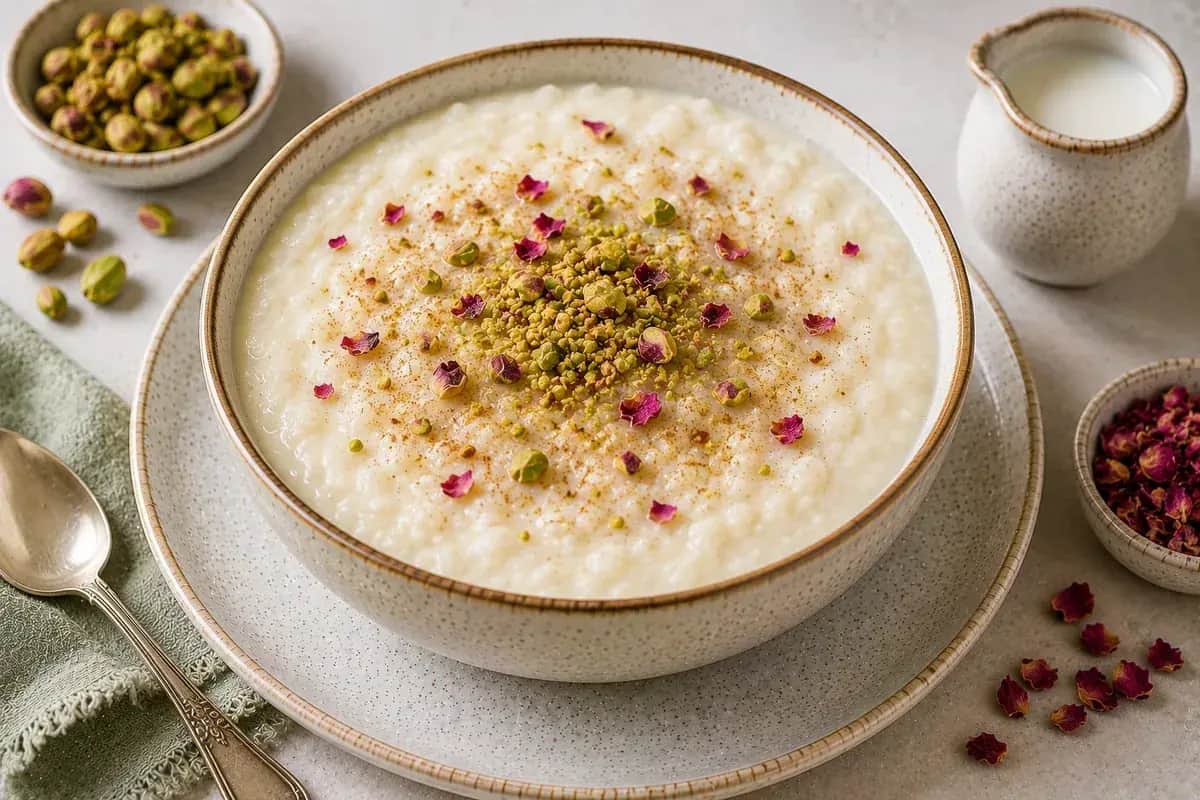
Healthy Roz Bel Laban Recipe — Egyptian Rice Pudding with Pistachios & Almonds
An Egyptian rice pudding made with milk, rice, gentle sweetness, cinnamon, and a nutty finish. Slow cooking gives the rice a creamy texture while keeping the dessert simple enough for everyday serving or make-ahead preparation.
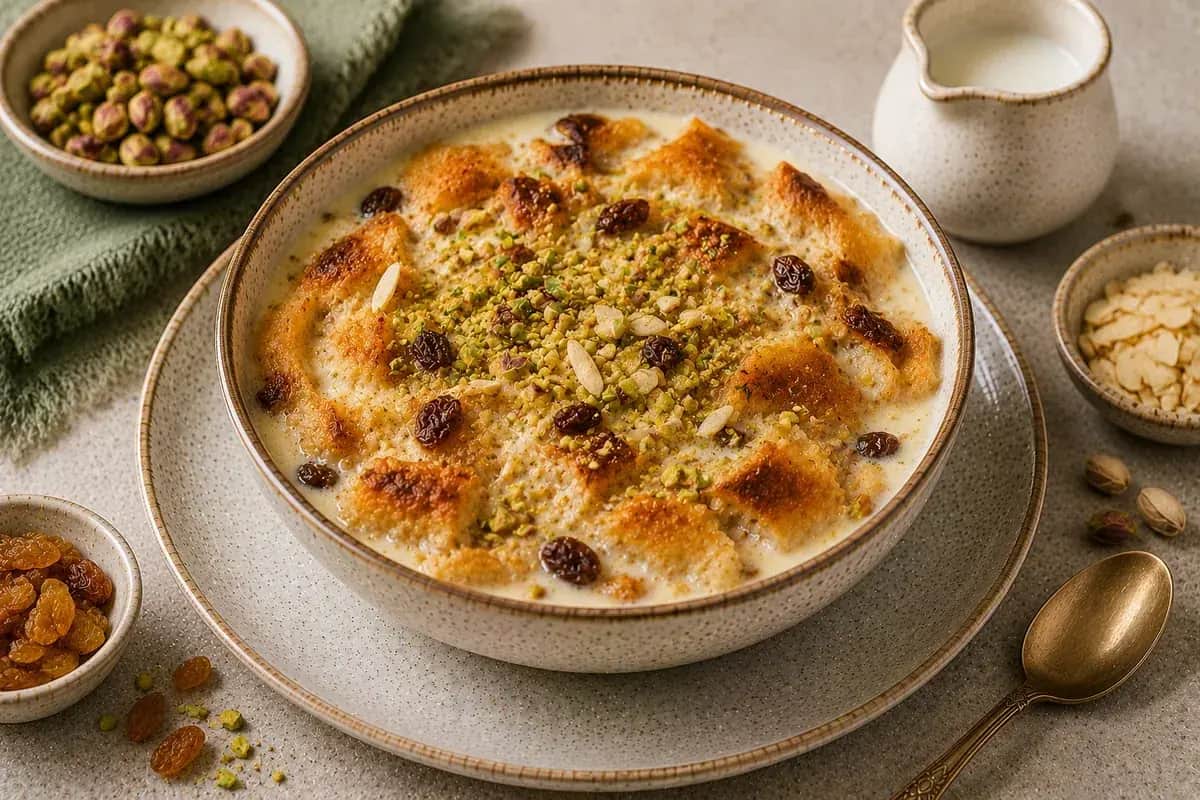
Healthy Om Ali Recipe — Egyptian Bread Pudding with Dates & Nuts
An Egyptian Om Ali made with baked pastry, milk, dried fruit, nuts, and warm spices. The pastry absorbs the sweetened milk as it bakes, creating a soft center with toasted edges and a nutty finish.
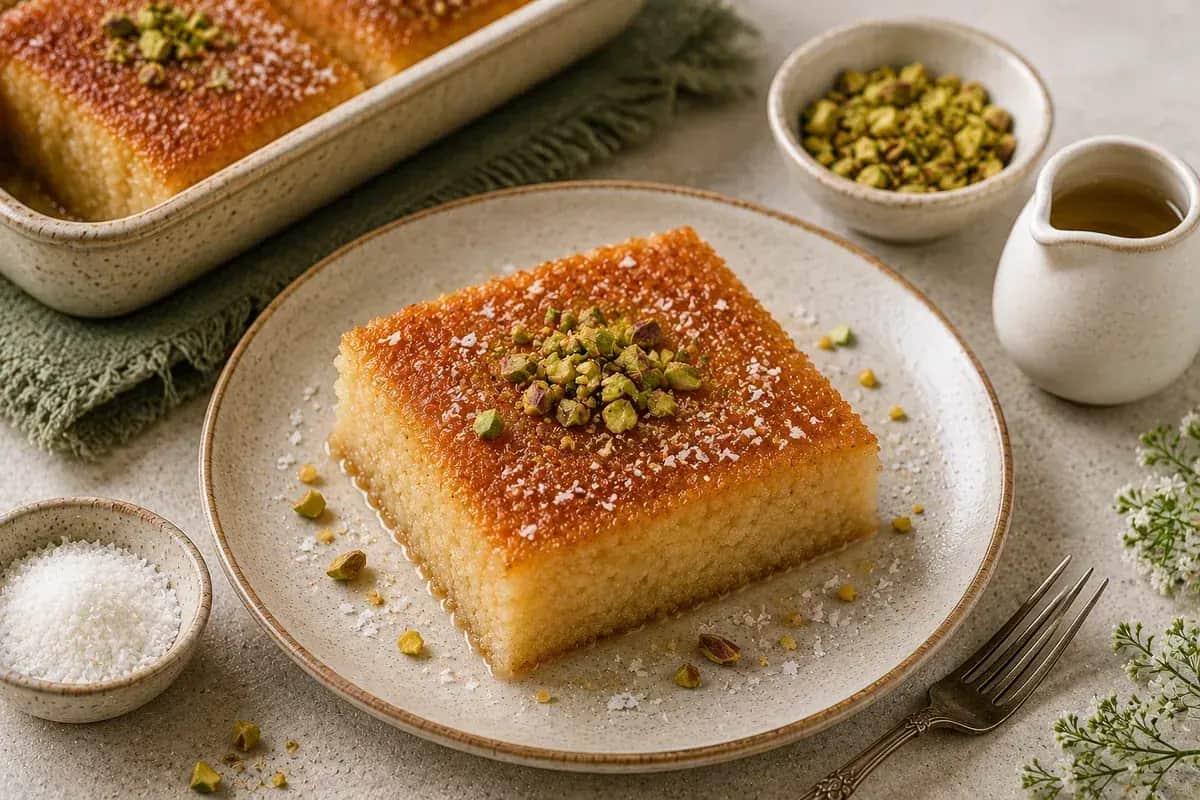
Healthy Basbousa Recipe — Light Egyptian Semolina Cake with Honey & Almonds
A lighter Egyptian basbousa made with semolina, yogurt, coconut, almonds, and a measured syrup. The cake bakes until golden and tender, then absorbs just enough syrup to give it the characteristic moist texture without becoming overly sweet.